
Pristine Streams
Protecting Rivers & Creeks from Wastewater Pollution
Very few of Texas’s rivers and creeks can still be described as pristine streams, which water quality scientists define as having extremely low levels of naturally occurring phosphorus. Even after treatment, domestic wastewater (aka sewage) contains higher levels of phosphorus, which acts as a fertilizer for plant growth. When treated wastewater is discharged into pristine streams, the result will be excessive algae growth.
Wastewater-related algae outbreaks have already happened on several pristine streams. The South San Gabriel River has been coated with miles of algae below the city of Liberty Hill’s wastewater discharge outlet for more than a decade. Excess algae grew on the Blanco River in 2019 when the city of Blanco discharged wastewater into it, but subsided the following year when the city resumed irrigating its wastewater onto land. These problems are why Save Texas Streams and our partners have championed the Pristine Streams proposal — because we don’t want to see the Liberty Hill disaster repeated on other rivers like the South San Gabriel.
The Pristine Streams proposal would allow TCEQ to continue issuing TLAP irrigation permits in the watersheds of these rivers and creeks, but to discontinue issuing most new TPDES discharge permits on them. In the proposal’s current form, pristine streams are defined as classified stream segments for which 75% of TCEQ-recorded water quality measurements over the past decade have shown that the amount of naturally occurring phosphorus in the stream has been below 60 micrograms per liter. Streams meeting this requirement have alreday been identified, with most of them located in the Hill Country (see map below). Only these streams would be covered by the proposal.
House Bill 4146 in the 2021 session of the Texas Legislature was based on the Pristine Streams proposal and was passed by the full House on an 82-61 vote. The proposal was also the basis of the Pristine Streams Petition, which was submitted to TCEQ in 2022 by Save Texas Streams and our allies. Most recently, the Pristine Streams proposal was the basis for Senate Bill 1911 in the 2025 session of the Legislature. Save Texas Streams will be working with our partners to have the Pristine Streams bill re-filed in the 2027 session.
Pristine Streams Proposed for Protection
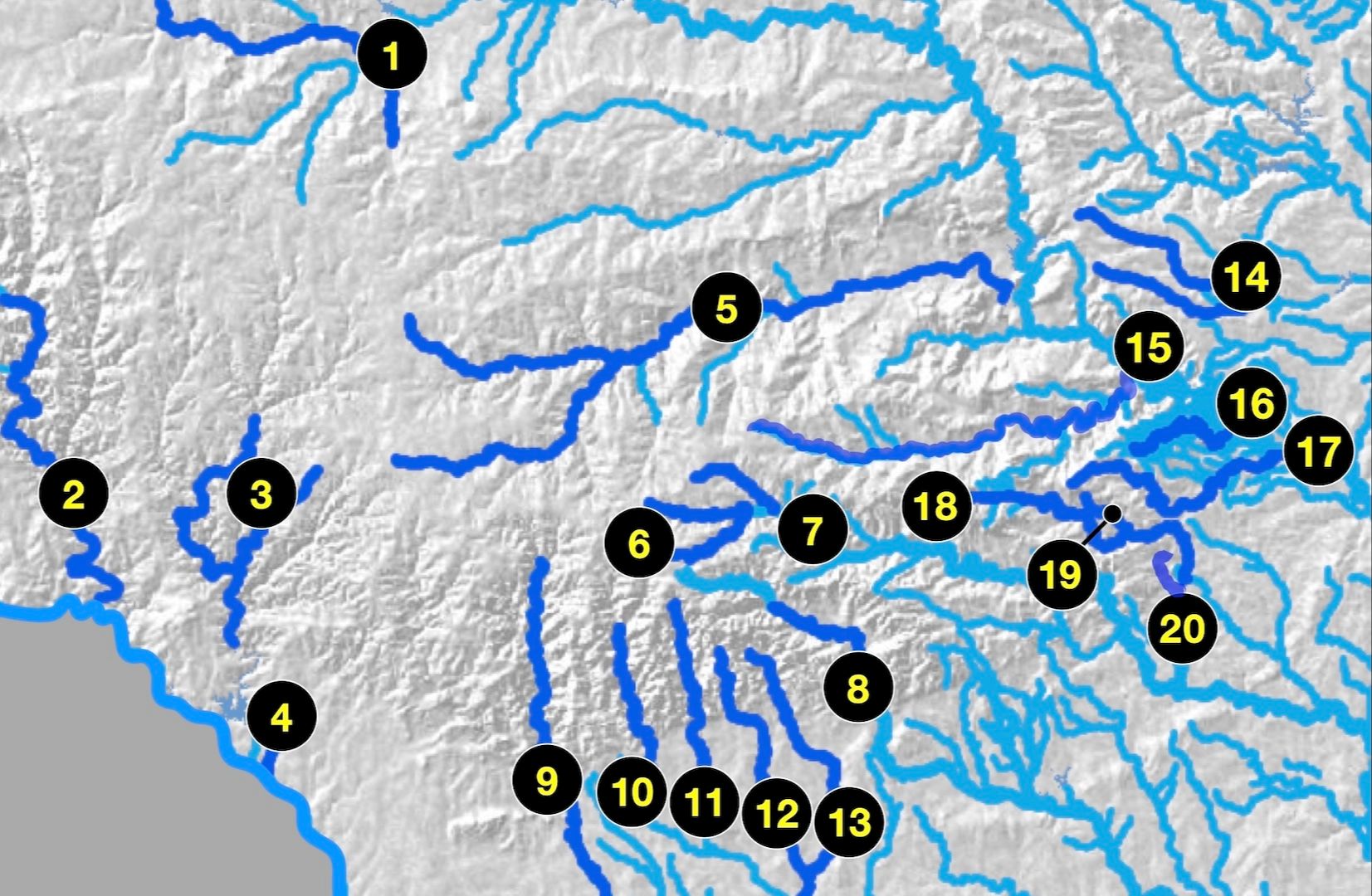
1 – Middle & South Concho River
2 – Upper & Lower Pecos River
3 – Devils River
4 – San Felipe Creek
5 – Llano River
6 – North & South Guadalupe River
7 – Johnson Creek
8 – Medina River above Medina Lake
9 – Upper Nueces River
10 – Upper Frio River
11 – Upper Sabinal River
12 – Seco Creek
13 – Hondo Creek
14 – North & South San Gabriel River
15 – Pedernales River
16 – Barton Creek
17 – Onion Creek
18 – Upper & Lower Blanco River
19 – Cypress Creek
20 – Upper San Marcos River
Not shown:
North & Salt Forks of Red River
Benefits
The Pristine Streams proposal will allow developers to continuing build on these rivers and creeks by using wastewater irrigation permits. TLAP permits have been successfully used for almost 40 years in a buffer zone around the Highland Lakes, where new wastewater discharge permits were discontinued in 1986. Development around the lakes has continued at a rapid clip since then — TCEQ has issued more than 30 irrigation permits around Lake Travis alone .An added benefit of the discharge prohibition has been that Austin’s drinking water, which comes from the Highland Lakes, contains almost no PFAS chemicals, which remain in wastewater after treatment. By contrast, PFAS chemicals from wastewater have been measured in the drinking water for other Texas cities.
The Pristine Streams proposal will protect the property rights and property values of landowners living downstream from wastewater facilities. Residents living below Liberty Hill’s wastewater outlet on the South San Gabriel have had to endure almost constant excessive algae growth that’s coated the entire surface of the stream and prevented them from enjoying the river. TCEQ’s commissioners acknowledged that excessive algae caused by wastewater can impair landowners’ ability to use a stream when they renewed Liberty Hill’s discharge permit in 2024 with the lowest-ever limit on phosphorus.
.
The Pristine Streams proposal will support economic development in the Hill Country, where more than 20 Pristine Streams are located. Many small businesses depend on the region’s reputation for unpolluted rivers and creeks, including B&Bs, restaurants, game preserves, wineries, breweries, and outdoor recreation outfitters for tubing, paddling, and fishing. According to the Governor’s Office, travelers spent $22 billion in the Hill Country in 2023.
Supporters
Sky Marshal Jones-Lewey was the creator of the Pristine Streams proposal. In her words: “The population of Texas continues to boom; we hear about it daily. Most people don’t think about the accompanying surge in the volume of wastewater that will come too and must be managed. Those of us who’ve been working to protect rivers for years most definitely think about that problem.”
Former Rep. Tracy O. King was the author of the 2021 Pristine Streams bill. In the discussion of the bill on the House floor, King said: “[I]f you're going to develop or if you’re going to build on a pristine stream that is an absolute Texas treasure, then you have to do it in a very responsible way. This is not an anti-development bill. This is a [bill for the] preservation of pristine streams.”
The Pristine Streams proposal has been endorsed by members of the Wastewater Conservation Coalition: Clean Water Action; Devils River Conservancy; Greater Edwards Aquifer Alliance (GEAA); Heart of Texas Conservancy; Hill Country Alliance; Llano River Watershed Alliance; National Wildlife Federation; Pedernales River Alliance; San Marcos River Foundation (SMRF); Save Our Springs Alliance (SOS); Save Texas Streams; Texas Real Estate Advocacy & Defense Coalition (TREAD); Texas Rivers Protection Association; Trinity Edwards Springs Protection Association (TESPA); and The Watershed Association.