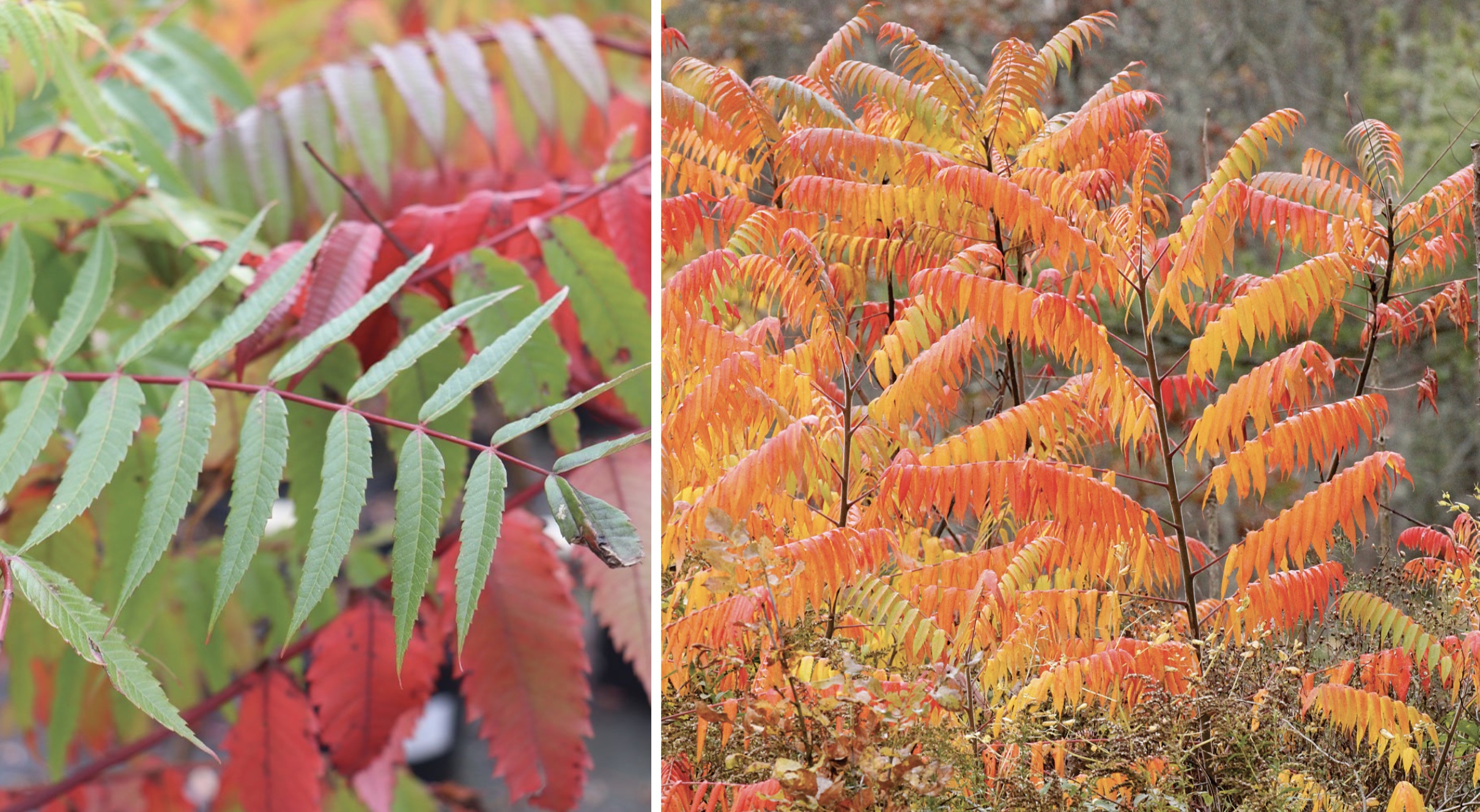
If you’ve ever driven through the Texas Hill Country in fall, you’ve likely noticed the brilliant reds and oranges of sumac trees. With their striking fall foliage and knack for thriving where little else will grow, true sumacs of the genus Rhus bring both color and character to the landscape. Members of the Anacardiaceae family, sumacs are distant relatives of cashews, mangos, poison ivy, poison oak, and pistachios. Their small flowers bloom in clusters from late spring to mid-summer. These trees tend to grow in dense thickets, as new seedlings sprout readily from the root system. Sumacs may easily take over areas of your yard unless planted in a raised bed.
True sumac fruits are nontoxic red berries with glandular hairs that grow in dense clusters, similar to their flowers. These fruits turn bright red when ripe in late summer and early fall and taste like citrus sour candy. Sumac berries can be infused in water to make a lemonade-like beverage commonly referred to as “sumac-ade” or dehydrated and ground into a spice which reportedly tastes great when sprinkled on grilled meats or hummus.
Sumac trees serve a number of ecological benefits, including being the host plant for the red-banded hairstreak butterfly and providing a valuable forage for birds and mammals when other food is scarce in winter. True sumacs generally prefer habitat with well-drained and dry soils and grow best in full sun, but can also tolerate partial shade. Geographic range differs depending on the species of sumac. There are five sumacs found in Texas, but not all are safe to touch — one dangerous imposter lurks among them… Read on to uncover which species is not a true sumac and the traits that make them each so distinctive!
Smooth sumac, or Rhus glabra, grows to reach 10 to 20 feet tall and exhibits pinnately compound leaves arranged alternately on the stem. Strikingly similar in appearance to flameleaf sumac, smooth sumac’s leaves turn fiery hues of orange and red in fall. The two species can be differentiated by their leaflet margins — finely serrated on smooth sumac and smooth on flameleaf sumac. Smooth sumac requires full sun to thrive and is most prominent in prairie and oak savanna ecosystems. Its geographic range includes most of the eastern United States with scattered smaller populations throughout the west. Smooth sumac bark is only smooth when young, developing scaly ridges with age.