
Early Spring Blooms of Central Texas
In Central Texas, spring arrives with vivid color and sweet fragrance. From magenta blossoms lining bare branches to delicate wildflowers carpeting the ground, early blooming plants provide essential nectar for pollinators and beauty for our landscapes. Read on to learn more about some of the first Central Texas native plants to grace us with their brilliant blossoms in early spring.
Texas Redbud:
The Texas redbud (Cercis canadensis var. texensis) is one of Central Texas’s most beloved early spring bloomers. This native tree typically grows 10 to 20 feet tall, making it a perfect fit for compact landscapes and smaller yards. In late winter and early spring, before its leaves even emerge, brilliant magenta-pink flowers bloom directly from its bare branches, creating a striking display that signals winter’s end. Often called the “love tree,” it later unfurls glossy, heart-shaped leaves 2 to 3 weeks later. The Texas redbud’s native range extends from southern Mexico, through Central Texas and into northeastern Mexico. This species thrives in limestone soils and is more drought-tolerant than its eastern redbud cousin, making it a great choice for water-wise landscaping. Texas redbud offers a range of ecosystem service; it attracts pollinators, hosts the Henry’s elfin butterfly, and, as a member of the legume family, improves soil fertility by fixing nitrogen.
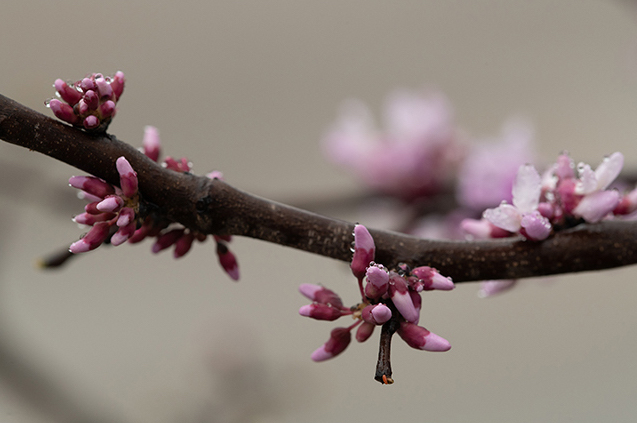
(Photo: Bruce Leander, Lady Bird Johnson Wildflower Center)
Mexican Plum:
The Mexican plum (Prunus mexicana) is a small, single-trunked deciduous tree that brings both fragrance and wildlife value to Central Texas landscapes. Growing anywhere from 10 to 35 feet tall, it produces clusters of delicate white blossoms from late winter to early spring, filling the air with a rich, fruity scent. Drought- and cold-tolerant, Mexican plum thrives in full sun to part shade. This species acts as the host plant for eastern tiger swallowtail butterfly, red-spotted purple butterfly, and cecropia moth larvae. Because it cannot self-pollinate, a tree growing in isolation may bloom beautifully but fail to produce fruit. Bees are its primary pollinators and essential partners in its life cycle. By mid- to late summer (July through September), the tree rewards successful pollination with yellow, red, and purple plums that are enjoyed by both people and wildlife.
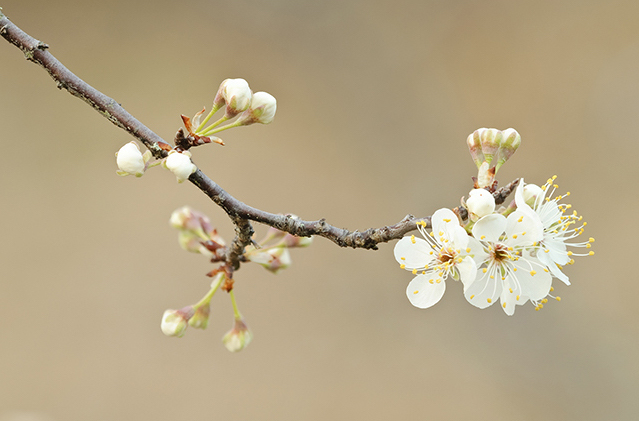
(Photo: Bruce Leander, Lady Bird Johnson Wildflower Center)

Golden Groundsel:
Golden groundsel (Packera aurea or Senecio aureus), also known as golden ragwort or butterweed, brightens Texas woodlands with golden yellow, daisy-like flowers about one inch across. In Central Texas, this member of the aster family can be found in bloom from February through May or June. Unlike many Texas natives adapted to dry conditions, this species prefers consistently moist soil, making it a good choice for shaded beds or low-lying areas that retain moisture. Native to much of the eastern United States, it naturally occurs in shady woodlands, meadows, bogs, and low woodland areas. In the garden, golden groundsel thrives in part shade to full shade and spreads readily by rhizomes to form an eye-catching groundcover. Its sunny blooms are a welcome nectar source for bees and butterflies, adding ecological value along with vibrant early-season color.
(Photo: Marilyin McBroom Knight, Lady Bird Johnson Wildflower Center)
Texas Mountain Laurel:
Texas mountain laurel (Dermatophyllum secundiflorum) is one of Central Texas's most iconic native plants, typically reaching 10 to 15 feet tall, though it may occasionally grow taller under ideal conditions. This small evergreen tree is prized for its dramatic clusters of lavender to deep purple flowers and an unmistakable fragrance often compared to that of artificial grape. A great choice for xeriscaping and pollinator gardens, it performs best in full sun and rewards gardeners with showy blooms that reliably draw in bees and butterflies. Texas mountain laurel’s native range extends from south-central and western Texas into New Mexico and as far south as San Luis PotosĂ, Mexico. The tree's red seed shells, commonly referred to as mescal beans or frijolitos, were historically prized by Native Americans for decorating clothing. All parts of the plant are poisonous to humans and animals and should not be consumed; even the honey made from bees that forage exclusively on Texas mountain laurel is highly toxic!
(Photo: Rachel Cywinski, Lady Bird Johnson Wildflower Center)
Pink Evening Primrose:
Pink evening primrose (Oenothera speciosa), commonly called pink ladies, pink buttercups, Mexican evening primrose, and showy evening primrose, is a cheerful harbinger of spring across Central Texas. Each delicate bloom features four soft pink petals forming a bowl around a bright yellow center. Pink evening primrose can be described as semi-evergreen, as it maintains its foliage only in select parts of its range with milder winters. Preferring full sun, this hardy perennial spreads readily by rhizomes, forming thick mats that make it an effective and eye-catching groundcover. This plant is originally native to the central North American grasslands from Nebraska and Missouri down through northeastern Mexico, but has naturalized itself to other regions to the east and west of this stretch over time. Throughout most of their ranges, evening primrose species unfurl their flowers at dusk and close them the following morning, supporting nighttime pollinators. However, pink evening primroses in the far south portion of its range, including Central Texas, tend to do the opposite—opening their flowers at dawn and closing them at dusk.
(Photo: Alan Cressler, Lady Bird Johnson Wildflower Center)

Mexican Buckeye:
Mexican buckeye (Ungnadia speciosa) is a multi-trunked deciduous shrub or small tree that brings beauty to Central Texas landscapes and typically grows 15 to 30 feet tall. Although not a true buckeye, the plant was named after its dark brown, round seeds that resemble a buck's eye. In late winter and early spring, clusters of showy pink flowers bloom along its bare light gray branches, attracting bees, butterflies, and other nectar-seeking insects. The honey from Mexican buckeye nectar is reportedly high-quality and particularly sweet. Well adapted to Central Texas, it thrives in limestone soils and is an excellent choice for xeriscaping. As temperatures cool in autumn, Mexican buckeye's foliage turns a striking golden yellow. Gardeners should be aware, however, that the leaves and seeds are poisonous to humans and should not be ingested.
(Photo: Ray Matthews, Lady Bird Johnson Wildflower Center)

Red Buckeye:
Red buckeye (Aesculus pavia) is a striking small tree or large shrub belonging to the horse-chestnut family. This species typically grows from a single trunk to reach 10 to 40 feet in height, with the shorter trees more prevalent to the west of the Mississippi Valley. Its brilliant red blooms form upright panicles measuring 4 to 10 inches long, creating a dramatic display that is especially attractive to ruby-throated hummingbirds in late winter and early spring when little other nectar is available. Other pollinators, including bumble bees, carpenter bees, and eastern tiger swallowtail butterflies also visit the nectar-rich flowers. Native to the southeastern United States, its range stretches from North Carolina southward and west into Central Texas. Red buckeye performs best in part sun to shade and moist, well-drained soils, making it an excellent understory choice. Red buckeye has a less common yellow-flowered variety (Aesculus pavia var. flavescens), commonly known as Texas yellow buckeye, yellow wooly buckeye, pale buckeye, and plateau yellow buckeye. In areas where their ranges overlap, red buckeye and Texas yellow buckeye may cross-pollinate, giving way to offspring with pink flowers. While beautiful and beneficial to pollinators, red buckeye is highly poisonous to humans, pets, and livestock, containing toxins that affect both the nervous and digestive systems if ingested.
(Photo: Ray Matthews, Lady Bird Johnson Wildflower Center)
If you enjoyed this article, we invite you to support our work, so that we can continue putting out content like this! Your donation also funds our advocacy efforts, which safeguard the waterways that define our region and support native plant growth and vitality. By protecting our beloved streams and rivers from threats like overdevelopment and pollution, we can ensure that these early blooming plants continue thrive in Central Texas landscapes.
We encourage you to check out our upcoming upcoming events, which can be viewed on the Guided Walks and Volunteer pages of our website. This month, we are excited to be partnering with Chi-Wei Chang and Cliff Tyllick to host 2 ecotherapy walks and an invasive tree removal volunteer day. Be sure to follow us on Facebook and Instagram — @SaveTexasStreams — to stay in the loop on all of our upcoming events, from monthly speaker sessions to volunteer efforts!
Responses