Header Logo
About
Vision History Staff and Board Contact Us
Our Work
Advocacy Overview Pristine Streams Barton Creek Hays County Williamson County Hill Country
Resources
All Newsletters Latest Issue Explorer's Guide
Support Us
Donate Sponsor Us Volunteer Guided Walks
← Back to all posts

Onion Creek: Cool Water and an Even Cooler History

by Logan Ferguson
Sep 02, 2025
Connect

For a moment, imagine you’re not staring at the pixels of our newsletter in your inbox, but rather, a gently flowing stream with bald cypress trees hugging its limestone banks. The sun is shining, the ruby-crowned kinglets are chirping, and the occasional cricket frog vocalizes its iconic call. Welcome to Onion Creek, one of Texas’s largest creeks and one of the six major streams directly contributing water into the Edwards Aquifer and Barton Springs. In fact, Onion Creek is the primary source of water to Barton Springs, contributing 34% of the flow at times! Considering that an average of 32 million gallons flow through Barton Springs daily, Onion Creek’s contribution to the springs is far from insignificant. It goes without saying that the purity of Barton Springs is directly impacted by our protection and stewardship of Onion Creek. 
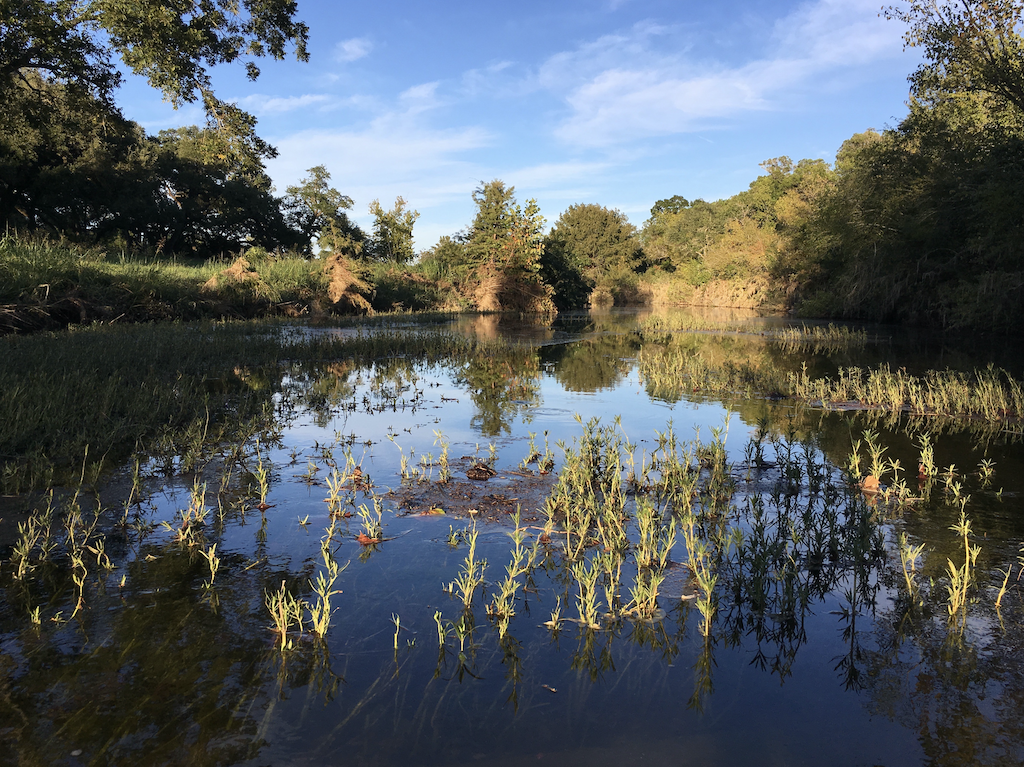
 

A view of Onion Creek near Camp Lucy, located west of Dripping Springs.


Eager to better understand the flow directions and rates of underground water in the Edwards Aquifer, scientists have conducted many dye tracer studies. They’ve poured nontoxic dye into caves and sinkholes across the Edwards Aquifer Recharge Zone and installed charcoal dye receptors in various wells and springs to detect its movement. These studies have shown that underground water can travel approximately 20 miles from Onion Creek near Buda to Barton Springs in as little as three days — exceptionally fast for water in an aquifer! Interestingly, these dye tracer studies have also confirmed that during high flow conditions in Onion Creek (generally during heavy rainfalls in the spring and fall), the underground flow below the creek can reverse direction, going southeast towards San Marcos Springs.

Surface water in streams flows directly underground into the Edwards Aquifer through cracks, sinkholes, and caves in the Hill Country’s karst limestone formations. Antioch Cave, located in the bed of Onion Creek near Buda, is the portal through which the largest amount of water from the creek seeps into the Edwards Aquifer. Due to the Edwards Aquifer’s uniquely fast underground flow rates, most chemicals and sediments  aren’t filtered out before its water emerges in springs.  

Subscribe to keep reading this post

Subscribe

Already have an account? Log in

Loading...
Sumac: Fall Colors, a Tasty Spice, and a Wildlife Café
If you’ve ever driven through the Texas Hill Country in fall, you’ve likely noticed the brilliant reds and oranges of sumac trees. With their striking fall foliage and knack for thriving where little else will grow, true sumacs of the genus Rhus bring both color and character to the landscape. Members of the Anacardiaceae family, sumacs are distant relatives of cashews, mangos, poison ivy, pois...
Vote Yes for Water - Vote Yes for Prop 4
The terrible floods that devastated the Hill Country in July obscured a basic fact: Texas is sliding into a full-blown water crisis. Two months before the floods, Canyon Lake was only 46% full; Lake Travis, 41%. While both of these crucial Hill Country drinking water sources are more full now, other reservoirs remain at dangerously low levels, especially the two that supply Corpus Christi — Cho...
How to Find Wastewater Permit Information on TCEQ's Website
We don’t say this often, but we want to congratulate the Texas Commission on Environmental Quality for making a big improvement to its website — the agency is now posting most draft wastewater permits online. If you’ve ever had to find a copy of a draft permit in the past, you know what a hassle that’s been. TCEQ’s only requirement was that a paper copy of the draft permit had to be placed in a...

Save Texas Streams Newsletter

Receive updates on key policy issues, environmental education on Central Texas ecology and natural history, and opportunities to get involved in protecting our streams and aquifers.
Footer Logo
© 2025 Save Texas Streams, a 501c3 organization
Powered by Kajabi

Join Our Free Trial

Get started today before this once in a lifetime opportunity expires.