
Prepare yourself for a striking display of fall foliage as our Texas red oaks begin to trade their green canopies for a blaze of deep orange and red. As part 1 to our Texas Fall Foliage Series, Save Texas Streams is spotlighting one of our favorite native trees, the Texas red oak! Texas red oak’s scientific name, Quercus buckleyi, honors the American geologist and botanist Samuel Botsford (S.B.) Buckley who discovered a number of plants and mollusks in the American South during the 1850s-1870s. Texas red oak is also commonly referred to ask Texas oak, Spanish oak, and Buckley’s oak. Don’t mistake it for Southern red oak — a separate East Texas species which happens to share its common name, Spanish oak.
This small-to-medium sized tree grows 40 to 50 feet tall on average with the tallest recorded Texas red oak reaching 70 feet. Texas red oaks tend to grow multiple trunks measuring roughly 10 inches in diameter. Their greyish brown bark is smooth on the younger branches and furrowed into ridges on the lower trunk and older branches. Their elliptic leaves are alternately arranged along the branch and divided into 5 to 9 deep lobes ending in bristle-tipped teeth. Glossy and dark green on the front sides and pale green and fuzzy on the undersides throughout spring and summer, these leaves transform to hues of deep orange and red in late fall.
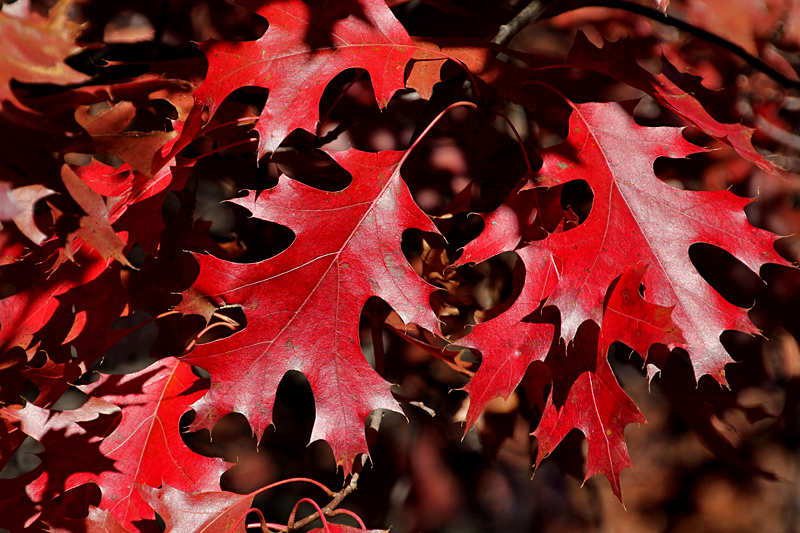
All photos by LAWNS Tree Farm
The Texas red oak’s native range extends from South Central Texas to North Central Oklahoma. Karst topography — like the limestone creek beds, slopes, and ridges we’re used to seeing throughout Central Texas — constitutes its native habitat. In fact, Texas red oaks dot the upper woodlands of the Texas Hill Country all the way west to around Sonora. This tree prefers alkaline soils, but will also tolerate neutral to slightly acidic soils.
Texas red oaks are monoecious, meaning both male and female reproductive parts exist on the same tree. They are also wind-pollinated and most often reproduce from self pollination. The male catkins pollinate the female flowers in spring, which then develop into tiny, unripe acorns the following fall. These acorns grow larger throughout the next spring and summer, eventually ripening and dropping to the ground that fall to then germinate and sprout the next generation of oaks. This two-year cycle allows extra time for pollination and explains why Texas red oaks drop so many acorns in their mast years.
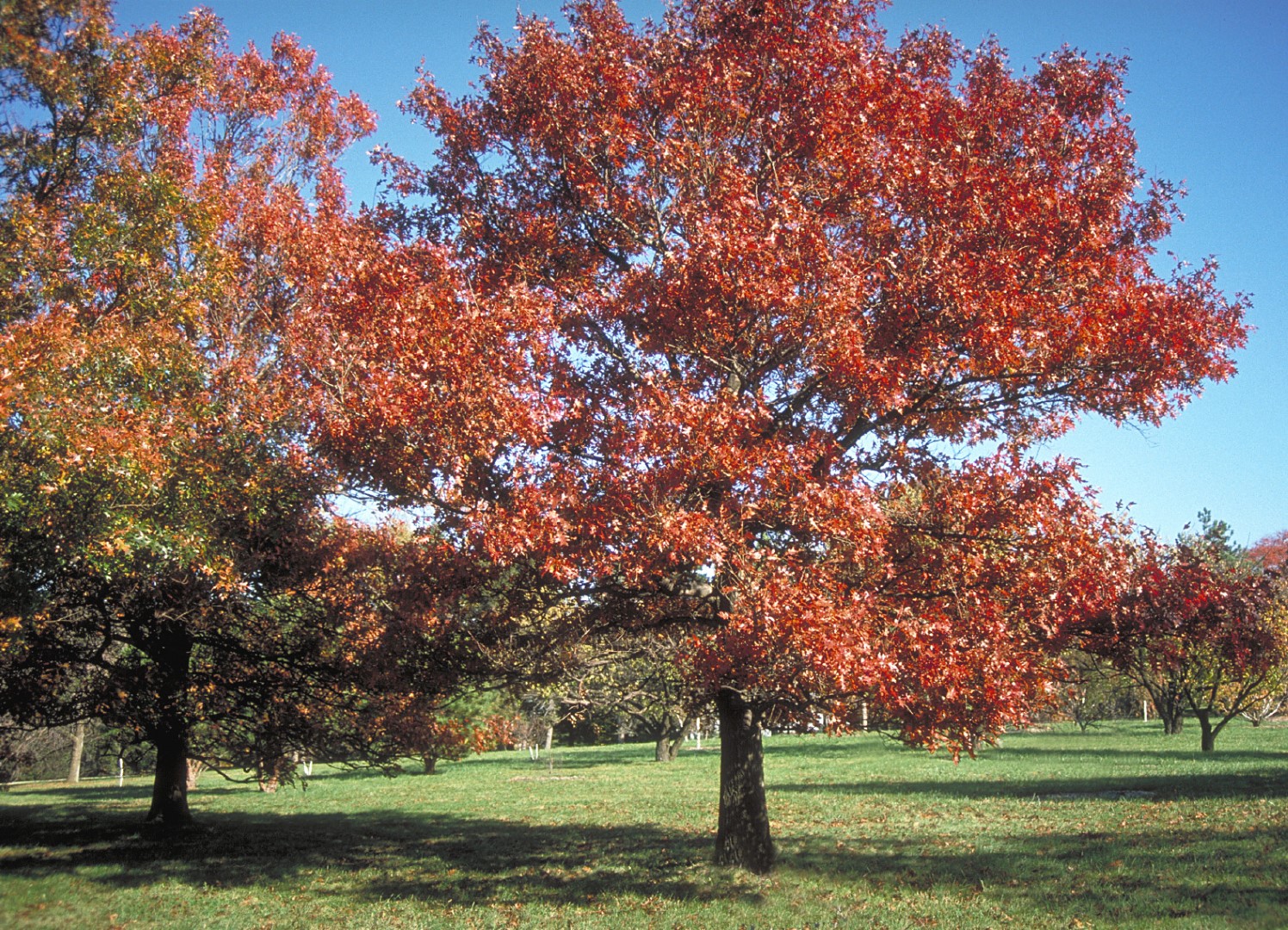
This deciduous tree is often mistaken for its close relative and lookalike, Quercus shumardii (commonly known as the Shumard oak), which is prevalent east of Austin. Shumard oak is sold at many plant nurseries and will readily hybridize with the Texas red oak. The two species share a similar appearance, but can be distinguished in several ways: Texas red oak is generally smaller, Shumard oak produces larger acorns, Shumard oak leaves have broader lobes, and Shumard oak grows as a single-trunked tree in contrast to the multi-trunked growth of Texas red oak. Although less hardy than the Shumard oak, the Texas red oak is better adapted to withstand drought and high temperatures. Texas red oaks tend to grow on the rocky hillsides of the Edwards Plateau, whereas Shumard oaks prefer flatter ground with deeper top soil.
Texas red oak offers a number of ecosystem services. Not only do their acorns provide winter forage for wildlife, but their dead trunks serve as nesting cavities for many small animals. The Texas red oak hosts the larvae of many moths and butterflies, including hairstreaks, duskywings, and the oak leaf roller moth (a favorite snack for the endangered Golden-cheeked warbler). Generally considered too small to harvest for timber, Texas red oak is more prized for its aesthetic appeal, ample shade cover, and low maintenance in landscaping.
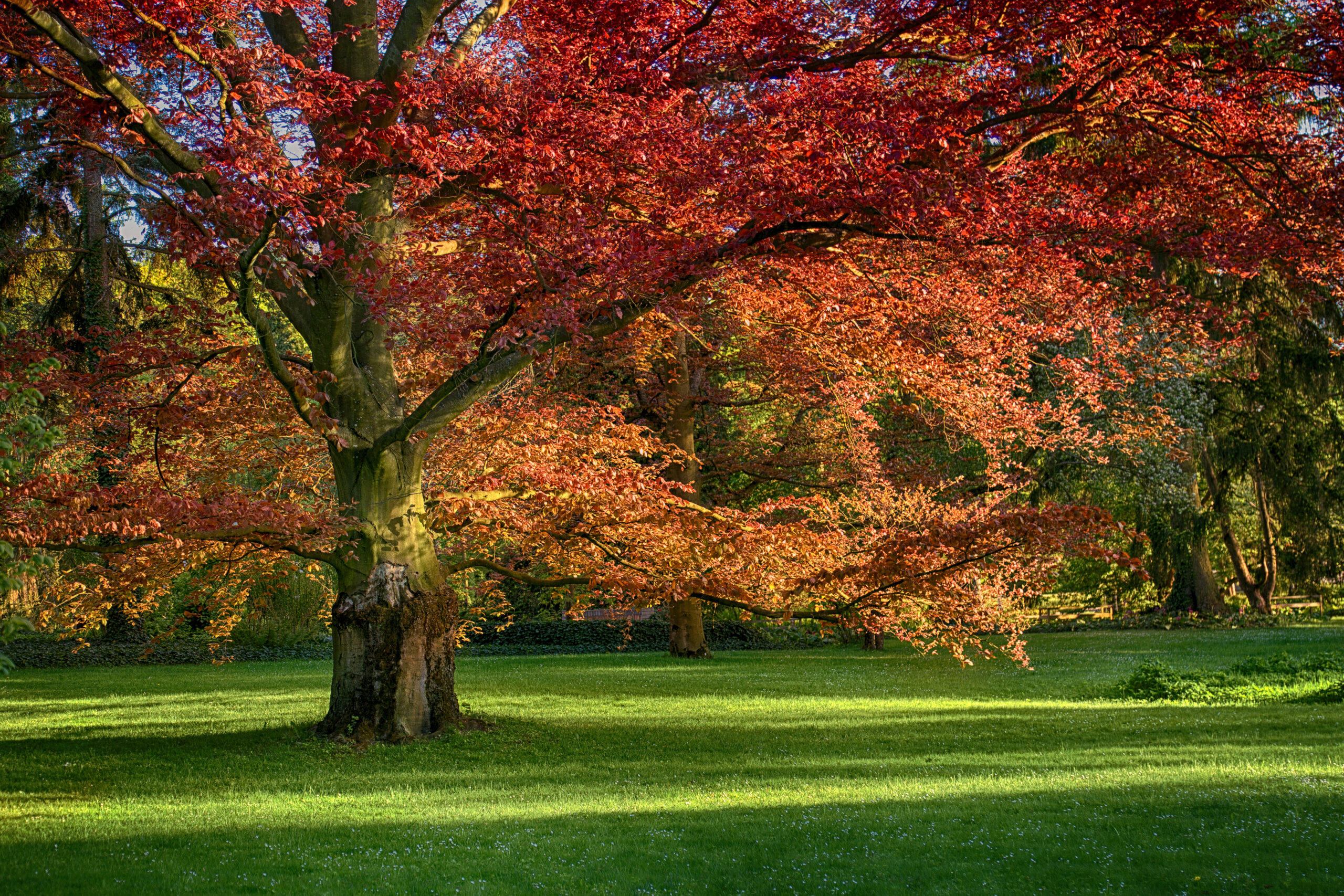
In many ways, the Texas red oak embodies the rugged beauty and resilience of the Hill Country itself — adapted to thrive in limestone soils, enduring the summer heat, and rewarding us each fall with its brilliant display of color. Those hoping to catch a glimpse of their fall foliage should consider visiting Wild Basin Wilderness Preserve or the Barton Creek Greenbelt where the trees put on some of their best seasonal shows. Whether admired for its fiery foliage or its role in sustaining wildlife, the Texas red oak stands as a vivid reminder of the natural treasures rooted in Texas's diverse terrain.




Responses