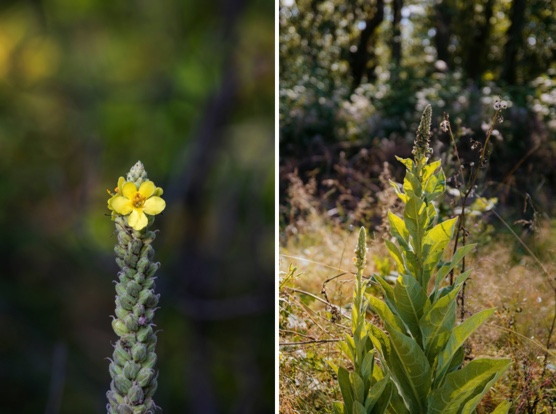
Don’t overlook what may seem like an unassuming roadside weed—this plant could be the natural remedy for your next stubborn cough or sore throat! Verbascum thapsus, widely known as common mullein, is one of over 300 species of mullein and a member of the Figwort or Snapdragon family, Scrophulariaceae. Mullein is highly invasive in North America and, thus, should not be grown intentionally in the garden or elsewhere. However, if found growing in the wild, this herb can serve a variety of practical purposes you’re probably not yet aware of! Common mullein is easily identifiable by its large, fuzzy leaves with simple margins, arranged oppositely on the stem. The plant can also be distinguished by its bright yellow blooms growing in a tall, narrow cluster at the tip of the stalk from May through September or October, somewhat resemblant of a corncob. The entire plant, from the leaves and the flower buds to the stem, are coated in tiny hairs, with the yellow flowers being the only part on the plant without a thin layer of fuzz.
Mullein was first introduced to the United States in the mid-1700s, in order to be used as a piscicide, or fish poison. The herb originates from Europe, Asia, and parts of northern Africa, where Indigenous Peoples would routinely crush up the seeds and scatter the powder in slow-moving water. The saponins in mullein seeds damage fish gill membranes, effectively suffocating the fish and making them easier to capture. This practice is now outlawed in the United States, as it often disrupts healthy ecosystem functioning if done routinely without allowing time for fish populations to bounce back. Common mullein thrives well in frequently disturbed sites that allow for easy germination. This drought-tolerant variety unfortunately tends to outcompete native species, due to its prolific seed production and high tolerance for poor soils that most plants struggle to flourish in.