Tell TCEQ: Don’t flood Salado Creek with treated sewage!
STS NEWS 01.25.26
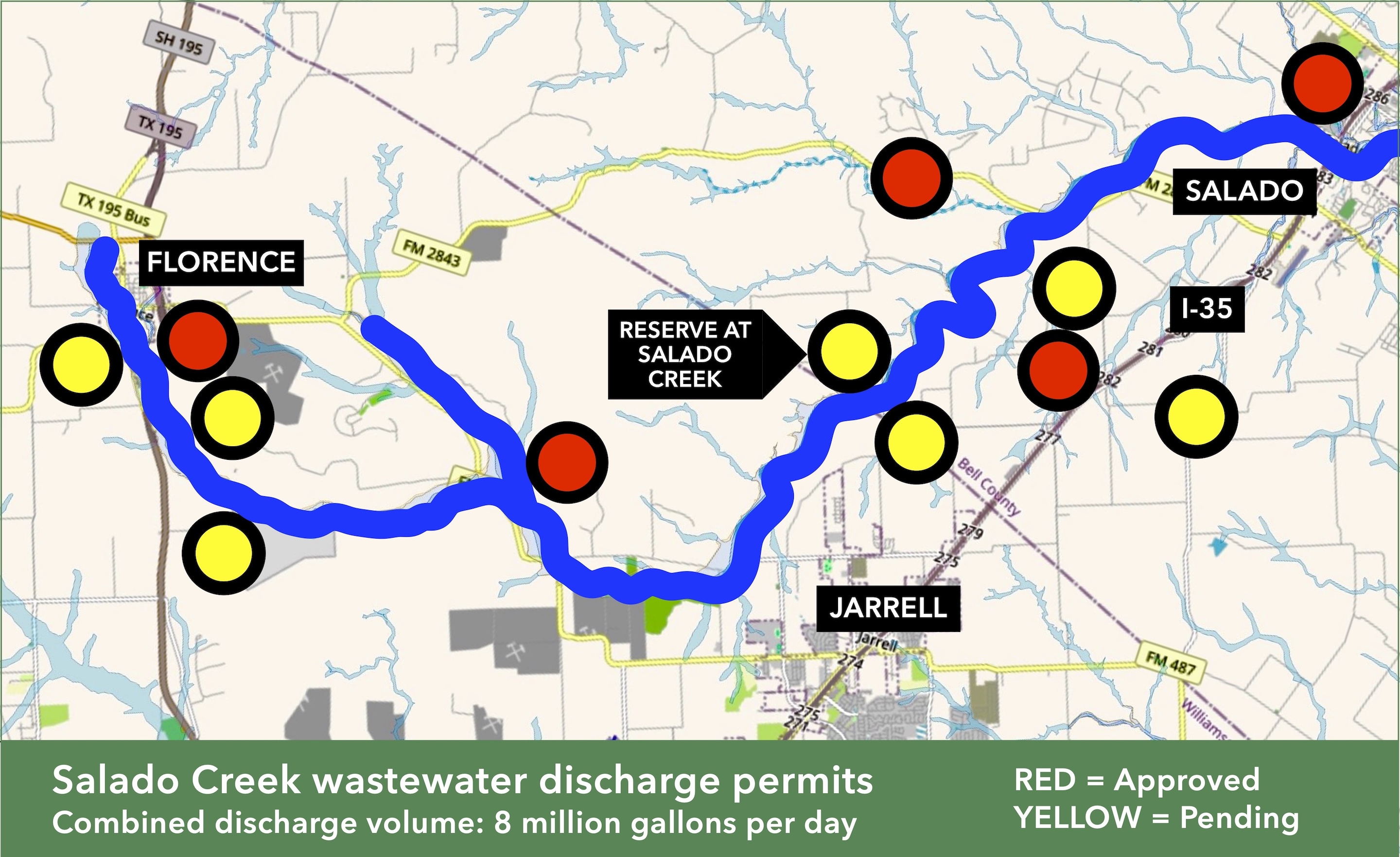
The Texas Commission on Environmental Quality (TCEQ) has been processing permit applications for 12 new wastewater facilities that could discharge up to 8 million gallons of inadequately treated sewage every day into Salado Creek. This is one of the largest concentrations of new wastewater permit applications anywhere in Texas. Salado Creek is a pristine stream that runs over the Edwards Aquifer Recharge Zone in Bell and Williamson Counties. TCEQ has already approved 5 of these applications, and if the agency approves all 12, the results could be disastrous.
The harmful effects on Salado Creek could include:
• algae blooms that would suffocate the creek and prevent people from wading, fishing, or swimming in it;
• potential wastewater contamination of nearby wells used for drinking water; and
• more threats to the endangered Salado Salamander.
TCEQ is currently accepting public comments on one of the pending permit applications, for The Reserve At Salado Creek. Save Texas Streams urges you to submit comments on the agency’s draft permit for The Reserve, either on TCEQ’s website or at a public meeting on January 27 (instructions below).

How to submit comments to TCEQ by January 27
You can file online comments on the draft permit for The Reserve At Salado Creek:
• Go to TCEQ’s website:
https://www14.tceq.texas.gov/epic/eComment/
• Enter permit number: WQ0016658001
• You can either type your remarks in the comment
box, or attach a letter as a PDF or Word file.
You can attend TCEQ’s public meeting on the draft permit for The Reserve At Salado Creek:
• The meeting will be held on January 27, Tuesday, at 7pm, at the Salado ISD Administration Building, 601 North Main Street, Salado 76571.
• During the first half of the meeting, attendees will be able to present questions for TCEQ’s staff and the applicant.
• During the second half of the meeting, each attendee will have 3 minutes to deliver comments on the permit. If you have more to say, you should also submit online comments on TCEQ’s website.
Tell TCEQ that the permit for The Reserve At Salado Creek must be either:
• a TLAP irrigation permit, because spraying the wastewater on land would keep it out of the creek, or:
• a TPDES discharge permit with a Total Phosphorus limit of 20 micrograms per liter, because adding any more phosphorus to the creek will fertilize huge algae blooms.
For more information, visit our website at savetexasstreams.org/saladocreek

Salado Creek runs through the town of Salado, a popular tourist destination on I-35 between Austin and Waco.
Questions for TCEQ about The Reserve’s draft permit
• Has TCEQ calculated the total impact on Salado Creek’s water quality if it approves all 12 discharge permits, or is it only considering each permit on a case-by-case basis?
• TCEQ banned new wastewater discharge permits over the Edwards Aquifer Recharge Zone in 1996 — but only south of the Colorado River. Why does the agency think it’s okay to issue discharge permits over the Recharge Zone north of the Colorado?
• How does TCEQ know that the new wastewater discharge facilities on Salado Creek won’t harm nearby wells? Does the agency have any impact data for wells near discharge facilities located elsewhere in the Recharge Zone?
• While TCEQ has banned new discharge permits in the southern Recharge Zone, it still issues permits that allow wastewater to be irrigated on land. Has the agency asked The Reserve’s developers to apply for an irrigation permit instead — which wouldn’t pollute Salado Creek or the Edwards Aquifer?
• Pristine streams like Salado Creek have very low levels of naturally occurring phosphorus. When treated wastewater with more phosphorus is discharged into a pristine stream, it fertilizes excessive algae growth. This has already happened on the South San Gabriel River below the discharge outlet for Liberty Hill’s treated wastewater. How does TCEQ know that its draft permit for The Reserve won’t lead to the same kind of algae outbreak on Salado Creek?

Algae blooms covered the South San Gabriel River for more than three miles below Liberty Hill’s wastewater outlet (yellow circle), as shown in these consecutive images from a 2020 drone video by Dr. Ryan King of Baylor University.
• When the city of Liberty Hill applied for a renewal of its permit to discharge treated wastewater into the South San Gabriel River, TCEQ’s staff permit proposed a phosphorus limit of 150 micrograms per liter. TCEQ’s commissioners thought that was too high, and they voted unanimously to issue Liberty Hill’s new permit with a phosphorus limit of 20 micrograms per liter instead. After being overruled on Liberty Hill’s permit, why does TCEQ’s staff think it’s okay to issue a permit with a phosphorus limit of 150 micrograms for The Reserve At Salado Creek?
• TCEQ must ensure that a new wastewater discharge permit won’t degrade a stream’s existing water quality by more than a minimal amount. However, TCEQ doesn’t record any measurements in its official Surface Water Quality Monitoring program for Salado Creek west of Interstate 35 — which is where all of the new discharge facilities would be located. If TCEQ doesn’t have its own data about Salado Creek’s water quality, how can it know whether its draft permit for The Reserve will maintain the creek’s existing water quality?
• Has TCEQ considered the potential impacts on the federally threatened Salado Salamander — not just from the draft permit for The Reserve, but from all 12 permit applications on Salado Creek? Has TCEQ consulted with the U.S. Fish & Wildlife Service about what provisions should be included in its discharge permits on Salado Creek in order to protect the salamander?

The endangered Salado Salamander (left) only lives in a few springs along Salado Creek, including Salado Springs (right).
Please donate to help us continue our work!
Save Texas Streams was founded in 1979 as Save Barton Creek Association. We work to protect the water quality and water supply in our state’s streams, aquifers, and watersheds. We are a member-supported nonprofit organization, and your contributions are essential for our work.
Responses