
Central Texas is home to a number of water snake species, but only one of them is venomous — the western cottonmouth, otherwise known as the water moccasin. Unfortunately, nonvenomous water snakes are often killed when mistakenly identified as cottonmouths and perceived as a life threat. We hope this article provides you with some useful tips to aid in accurately identifying Central Texas water snakes and a newfound knowledge with which to better appreciate of these fangtastic creatures!
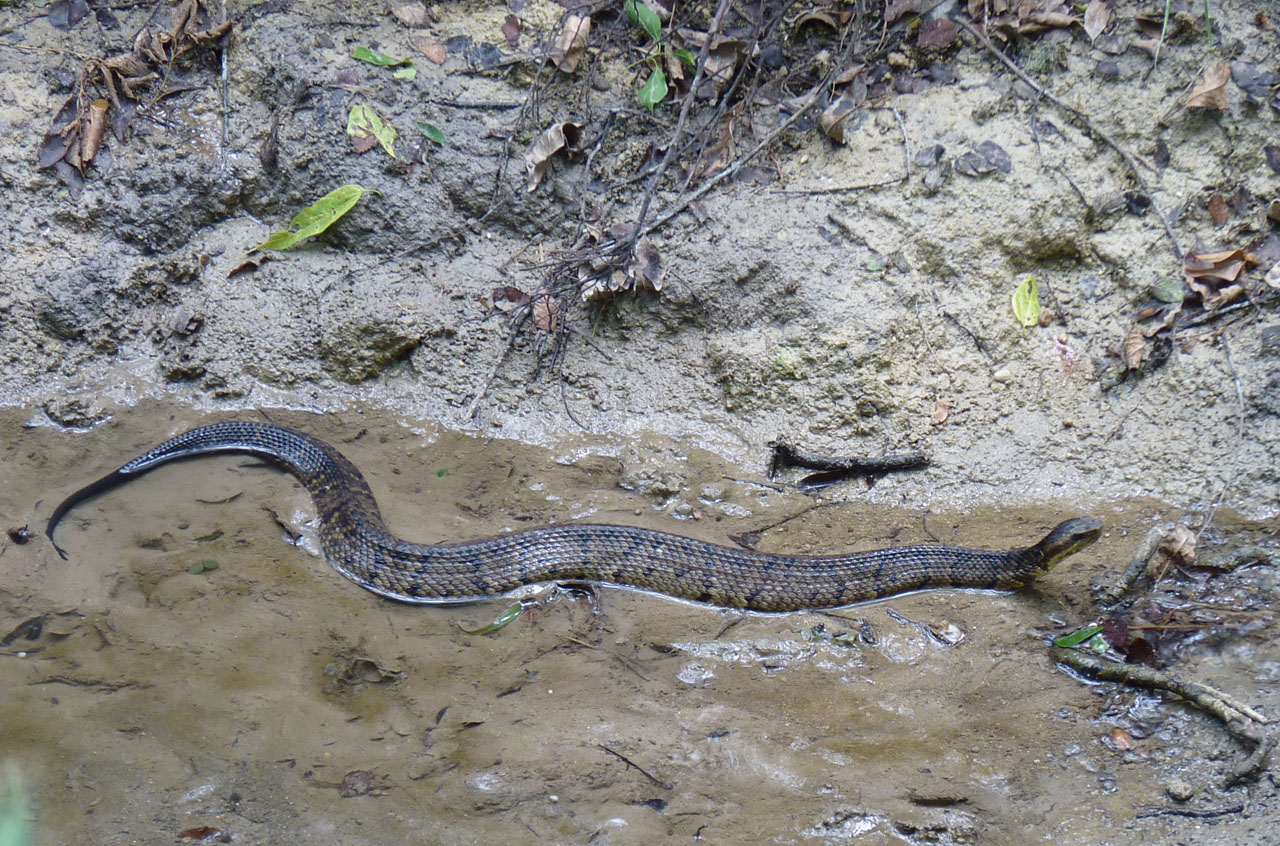
Western cottonmouth in Palmetto State Park east of San Antonio (Tom Spinker, Flickr)
Please make our recommended observations from a safe distance of at least two meters. Under the very rare and unfortunate circumstances that you or someone you know is bitten, medical attention should be sought out immediately. Whether the species is venomous or not, all snake bites should be assessed by a medical professional as quickly as possible to prevent a nasty infection.
POV: You’re out on a hike along the river and you spot what you’ve deduced is, in fact, not a stick floating in the water, but a water snake. Instead of immediately jumping to the likely false assumption that this is a cottonmouth, let us guide you through a series of questions to accurately identify the species.
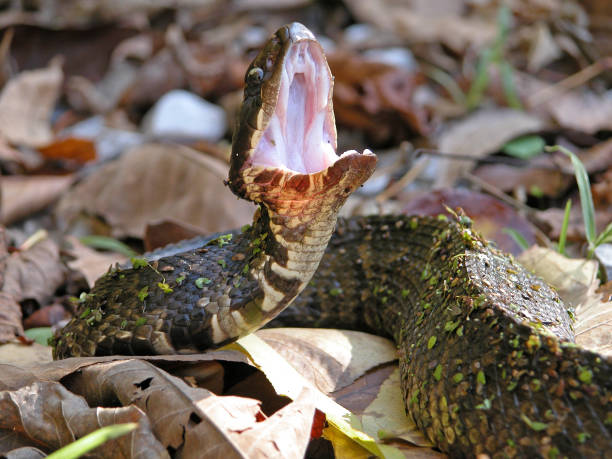
The 'cotton mouth' of the western cottonmouth.
To start, let's determine whether this slithery specimen is a nonvenomous water snake or a western cottonmouth.
1) From what you can tell from a distance of 2 meters or more, does the snake have vertical pupils? If in doubt, skip this question.
Yes = A
No = B
2) Does the snake have a large, girthy body with a short, stubby tail?
Yes = A
No = B
It is important to note that when threatened, nonvenomous water snakes often press their bodies against the ground to appear larger and more intimidating. You can tell if a nonvenomous snake is flattening its body by the shape of its head; if it appears flat and triangular, you’ve likely encountered a nonvenomous snake.
If the snake is clearly performing this defense mechanism, answer “no.”
3) Was the snake spotted climbing in a tree?
Yes = B
No = A
4) Does the snake exhibit dark vertical bars running parallel underneath the jaw?
Yes = B
No = A
Any water snake found in the United States with dark bars running vertically underneath the jaw is nonvenomous! (This rule only applies to water snakes in the United States.)
5) If spotted swimming, was the snake’s head above the water? (If not observed in the water, skip this question.)
Yes = A
No = B
6) Is the snake’s head large and blocky, compared to the rest of its body?
Yes = A
No = B
7) Does the snake have a cotton-white mouth? (Skip this question if the snake was not seen gaping.)
Yes = A
No = B
Count your number of A's versus B’s. If you counted more A’s than B’s, you have likely found yourself a western cottonmouth. Take a deep breath and a couple of steps back. This snake wants as little to do with you as you want to do with it! Most water moccasin bites occur when a person accidentally steps on a snake or is purposefully taunting it. Urban myths claim cottonmouths chase innocent hikers for miles after their first encounter, but these stories could not be further from the truth. Snakes have no reason to chase humans, as they do not prey on humans. If you happen to spot the same snake along your route, it is not conspiring against you, but rather, simply happens to be travelling in the same direction.
If you counted more B's than A's, you've probably run into either a diamondback water snake or plain-bellied water snake. Read on to uncover which of these two snakes has crossed your path.
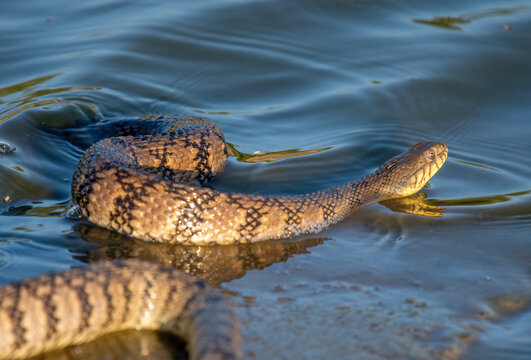
Diamondback Water Snake — not venomous!
Does the snake’s back have chain-like patterned scales and dark bars running parallel along either side of the body? If yes, the lovely Diamondback water snake (pictured above) has likely graced your presence! This snake inhabits much of the southeastern United States and prefers to reside near slow-moving water with low-hanging vegetation. They are primarily nocturnal, but more active during the day in spring and fall. The diamondback water snake exhibits strongly keeled scales, meaning each scale has a distinctive ridge running down the center. These snakes are often confused with cottonmouths due to their large, stocky bodies, but despite their intimidating appearance, they are actually a particularly nonaggressive species. Although unlikely to attack, their bite has been reported to be exceptionally painful, due to their sharp teeth, perfect for holding slippery fish and frogs.
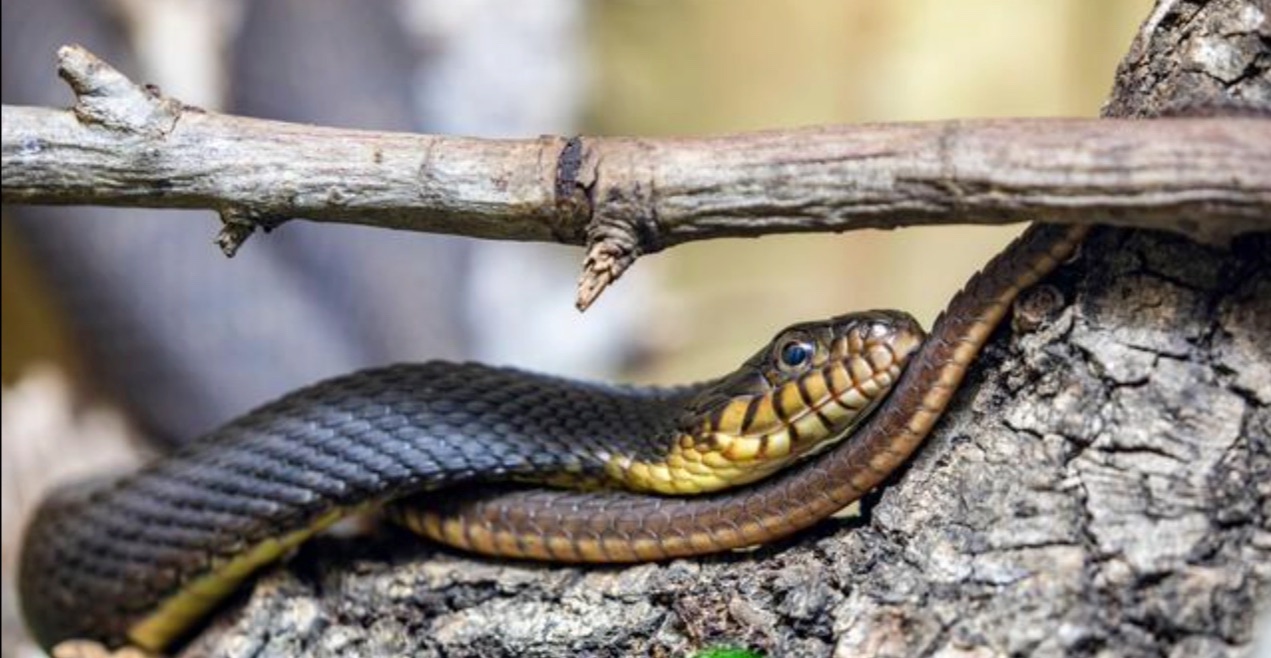
Plain-bellied water snake — also not venomous!
If the snake exhibits dark, vertical bars running parallel underneath the jaw and no patterning on its underside, you’ve likely stumbled upon a plain-bellied water snake. Similar to the diamondback water snake, this species is generally nonaggressive, quick to dive into the water and dart away if approached. Plain-bellied water snakes are skillful hunters, both on land and in water, feeding mostly on frogs and toads. Juveniles display crossband patterning and alternating blotches on their backs, which eventually fade into a uniform coloration as mature, adult snakes. Plain-bellied water snakes are only active in the hottest months of the year and have been known to travel far distances from the water on warm, sunny days. So, if you’re trying to identify a snake on your summer hike with no water in sight, don’t rule out the plain-bellied water snake!
Next time you spot a snake gliding through the water or basking along the stream bank, you'll be equipped to look past the fear and accurately identify the fascinating creature in front of you. Most water snake encounters end the same way; the snake wants nothing to do with you and will retreat given the chance. So take a breath, keep your distance, and let curiosity from a safe distance guide your next riverside encounter. After all, a little knowledge goes a long way toward coexisting with our scaly neighbors.



Responses