
Did you know that 53.5% of Texas’s drinking water comes from aquifers? There are 4 major aquifers in Central Texas, all of which are essential to sustaining our municipalities, livestock, agricultural irrigation, and diverse wildlife. In this article, Save Texas Streams aims to dig deep into our region’s aquifer systems, uncovering the topography, hydrogeology, and geography that make them each so distinctive, while also highlighting the hydraulic connections that exist between them. We hope you enjoy this deep dive into Central Texas aquifers!
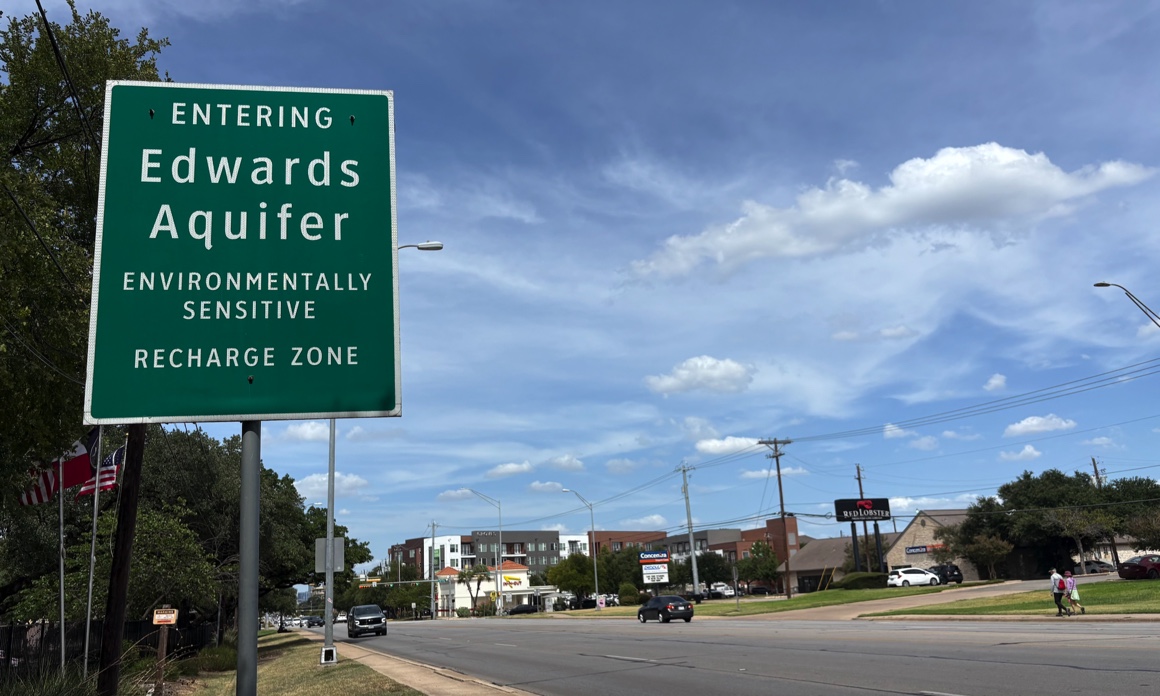
Aquifers are essentially underground water reservoirs that are refilled, or recharged, when surface water percolates through layers of porous rock. Any surface area through which water infiltrates and replenishes an aquifer is commonly referred to as a recharge zone. Travis and Hays country residents are likely familiar with road signs that read, “Entering Edwards Aquifer environmentally sensitive Recharge Zone.” These signs were installed with the intention of raising awareness for the aquifer’s water quality and preventing groundwater contamination from surface activities. Conversely, an aquifer contributing zone is any area where surface water will eventually flow through streams or rivers into a recharge zone and contribute to an aquifer. Due to Central Texas’s varied geology, the depth of the aquifers beneath our feet ranges from just a few meters below the surface to several hundred meters deep. Aquifer depth refers to the distance between the ground we walk on and the base of the aquifer below, while saturated thickness is the vertical distance from the top of the aquifer’s water table to the base of the aquifer.
Most people tend to imagine aquifers as still, stagnant underground pools, but this is far from the case. The water under our feet is very much active, constantly flowing as part of the greater hydrological system. Aquifer water seeps through cracks and fissures, follows currents, and can even undergo immense pressure, propelling it back up to the surface through artesian springs. Aquifers with artesian springs are referred to as confined, because the water within them is trapped between two confining layers of impermeable rock. Artesian springs occur when confined aquifers experience high-pressure conditions, causing the water to shoot up through any accessible channel. This is how Barton Springs and many other springs that feed Texas Hill Country rivers formed! Aquifers that are not sandwiched between layers of impermeable rock are known as unconfined aquifers and do not experience these same high-pressure conditions. The map below delineates Texas’s 9 major aquifers and distinguishes their outcrops from their subcrops. Aquifer outcrops are the areas of aquifer exposed to the surface and are most often unconfined, while aquifer subcrops are the areas of aquifer buried beneath other formations and typically signify confined conditions.
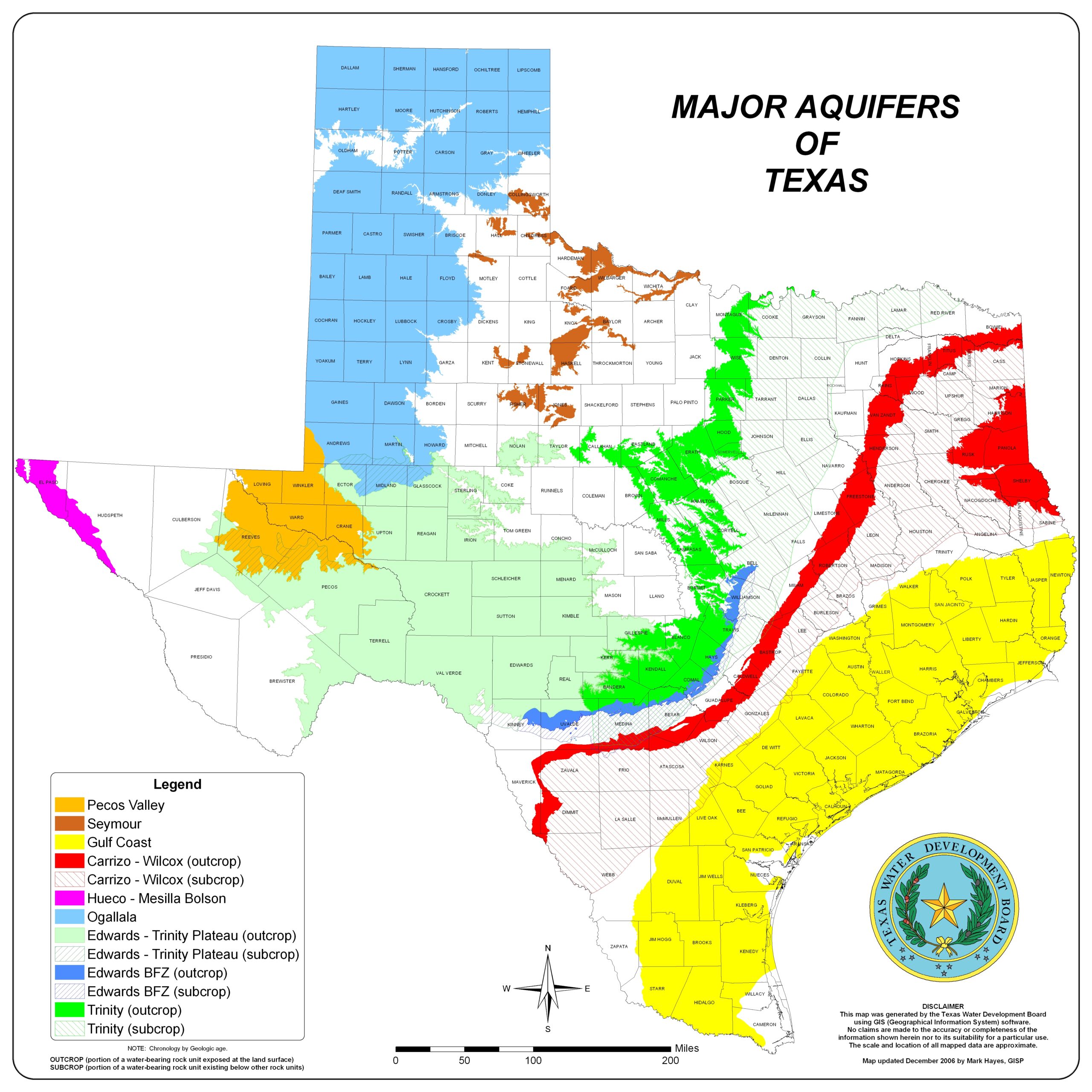
Major Aquifers of Texas (Mark Hayes & Texas Water Development Board, 2006)
Carrizo-Wilcox Aquifer
The Carrizo-Wilcox Aquifer runs adjacent to and northwest of the Gulf Coast Aquifer, extending from the Mexico border to parts of Louisiana and Arkansas. Spanning 66 counties, this vast aquifer has been divided into three regions—Northern, Central, and Southern—to support more effective hydraulic modeling and water resource planning. The Northern region is primarily recharged by water originating from the Brazos, Trinity, Neches, Sabine, and Red River basins. In the Central region, most of the inflow comes from the Brazos, Trinity, and Colorado River basins. Meanwhile, the Southern region draws the bulk of its water from the Rio Grande, Nueces, San Antonio, Guadalupe, Colorado, and Lavaca River basins.
The aquifer’s geological makeup consists primarily of gravel, silt, clay, and lignite deposited during the Tertiary Period. It experiences unconfined conditions in its outcrop and confined conditions in its subcrop. Groundwater at lower depths undergoes greater pressure and higher temperatures, resulting in higher concentrations of dissolved minerals like iron. Natural chemicals from dissolved minerals, including methane, hydrogen sulfide, fluoride, and chloride, are concentrated in deeper waters, as well. Carrizo-Wilcox water typically requires treatment to ensure its chemical compatibility with Edwards water when the two are mixed in a shared distribution system.
Edwards Aquifer
The Edwards Aquifer forms a narrow band, extending along the Balcones Escarpment and underlying 13 counties from north of Georgetown to Uvalde and Brackettville. The aquifer is split into three sections by natural groundwater divides at Kyle in Hays County and the Colorado River, with the central section known as the Barton Springs segment. Water enters the Edwards Aquifer primarily through leaky streambeds in the Edwards Aquifer Recharge Zone, which includes parts of Kinney, Uvalde, Medina, Bexar, Comal, Hays, and Travis counties. Two-thirds of all Edwards Aquifer Recharge occurs west of San Antonio. The Edwards Aquifer has the most artesian springs of any Texas aquifer due to its generally confined, high water pressure conditions. Many of the most beloved Texas Hill Country streams flow from Edwards Aquifer artesian springs, including the Comal and San Marcos Rivers.
The Edwards Aquifer underlies some of Texas’s most ecologically sensitive areas, nourishing the flora and fauna that depend on the region’s spring-fed rivers and streams for survival. It also provides critical habitat for over 40 aquatic, subterranean species, including 7 that are endangered and 1 listed as threatened. The dark caves, sinkholes, and fissures of the Edwards Aquifer are also home to karst-dwelling invertebrates, 16 of which (6 insects and 10 arachnids) are listed as endangered. Many of these threatened and endangered species rely on consistent, high-volume, and fresh spring flow to survive, including the Comal Springs riffle beetle, Comal Springs dryopid beetle, fountain darter, Peck’s cave amphipod, Barton Springs salamander, Texas blind salamander, and San Marcos salamander. Safeguarding the aquifer’s water quality is therefore essential to protecting the delicate ecosystems of these many vulnerable species.
The Edwards Aquifer provides approximately 90% of San Antonio’s drinking water and is also the main source of drinking water for numerous surrounding Hill Country communities. In 1993, the Texas Legislature established the Edwards Aquifer Authority (EAA) to regulate groundwater pumping and ensure fair access to the aquifer for users from Uvalde County to parts of Hays County. The Barton Springs–Edwards Aquifer Conservation District oversees aquifer management for the remaining areas of Hays County and southern Travis County, while the Kinney County Groundwater Conservation District manages the aquifer segment within Kinney County.
Trinity Aquifer
The Trinity Aquifer encompasses a large surface area, stretching from Northeastern to Central Texas and is composed of numerous smaller aquifers that were formed at different times throughout the Cretaceous Period. These aquifers include the Antlers, Glen Rose, Plauxy, Twin Mountains, Travis Peak, Hensell, and Hosston and have been categorized into three sections – the Lower Trinity, Middle Trinity, and Upper Trinity – each defined by distinctive geological formations. As one of the most highly used groundwater resources in the state, the Trinity supplies much of the water for municipalities, livestock, irrigation, and other domestic purposes in North and Central Texas. The Trinity Aquifer, along with the Edwards-Trinity Plateau Aquifer, are the primary sources of water for the Texas Hill Country.
Sulfate, chloride, and total dissolved solids tend to increase with aquifer depth. The Trinity Aquifer’s saturated thickness ranges from just about 600 feet in North Texas to roughly 1,900 feet in Central Texas. It experiences confined and unconfined conditions, and recharge and groundwater flow are considerably slower than that of the Edwards Aquifer, due to its less permeable rocks. Scientists found that only 4-5% of the rainwater that falls over the Trinity Aquifer Recharge Zone actually enters the aquifer.
The Trinity and Edwards Aquifers share some of the same geographic range and are hydraulically connected along the Balcones Escarpment. The Balcones Fault’s tectonic activity has caused the younger Edwards limestone to be downthrown next to the older Trinity layers, allowing for water exchange between the two. The Trinity Aquifer often directly recharges the Edwards through fault lines that create pathways between the two reservoirs.
Edwards-Trinity Plateau Aquifer
The Edwards-Trinity Plateau Aquifer lies beneath the Edwards Plateau, spanning 35,000 square miles and all or parts of 38 counties. Over time, this aquifer has played a vital role in shaping the region’s distinctive landscape. Its spring waters gave rise to the streams and rivers which flowed off the plateau’s edge and gradually carved the deep canyons that define today’s Texas Hill Country. Unfortunately, most of these springs have ceased flowing due to prolonged drought and over-pumping. Over two-thirds of the groundwater pumped is used for irrigation, with the remainder used for livestock and municipalities. Edwards-Trinity Plateau Aquifer water is generally fresh, except for in the Trans-Pecos where Permian evaporite sediments, agricultural runoff, and oilfield brine degrade the quality.
The aquifer was named after its Edwards and Trinity geologic formations that formed as the early Cretaceous Sea advanced across Texas, depositing sediments. The Trinity formations, composed primarily of sand and sandstone, were deposited first, followed by the dolomite and limestone layers of the Edwards formations. Although generally separated by impermeable rock, the two formations hydraulically connect in certain areas through natural cracks and fissures. This connection allows the two formations to function as a single system, leading to their classification as one aquifer rather than two. The Edwards-Trinity Plateau Aquifer shares hydraulic connections with other major aquifers, including the Edwards, Trinity, and Ogallala. The aquifer’s saturated thickness ranges from less than 100 feet in the north to greater than 800 feet in the south and varies the greatest along its western boundary. The aquifer experiences mainly unconfined conditions and water typically contains high concentrations of dissolved minerals.
Most aquifers depend almost entirely on rainfall to replenish their water reserves. As Central Texas grapples with ongoing drought, safeguarding the health of our aquifers is more urgent than ever. One of the most effective tools we have is protecting pervious cover—natural landscapes like grasslands, forests, and undisturbed soils that allow rainwater to soak into the ground and recharge the aquifers below. In contrast, impervious surfaces such as roads, rooftops, and parking lots prevent infiltration, leading to reduced aquifer recharge, increased runoff, and elevated flood risk. During drought, recharge opportunities are already limited, and with less water entering the aquifers, the concentration of pollutants from surface activities rises. Maintaining natural pervious cover not only supports more consistent and cleaner recharge but also acts as a buffer against flash flooding by absorbing and slowing stormwater runoff. As population growth and development continue across Central Texas, prioritizing land management practices that protect our recharge zones will be key to preserving both the quantity and quality of this vital underground resource. Save Texas Streams will continue to advocate for green spaces to ensure the long-term protection and resilience of our aquifers.




Responses