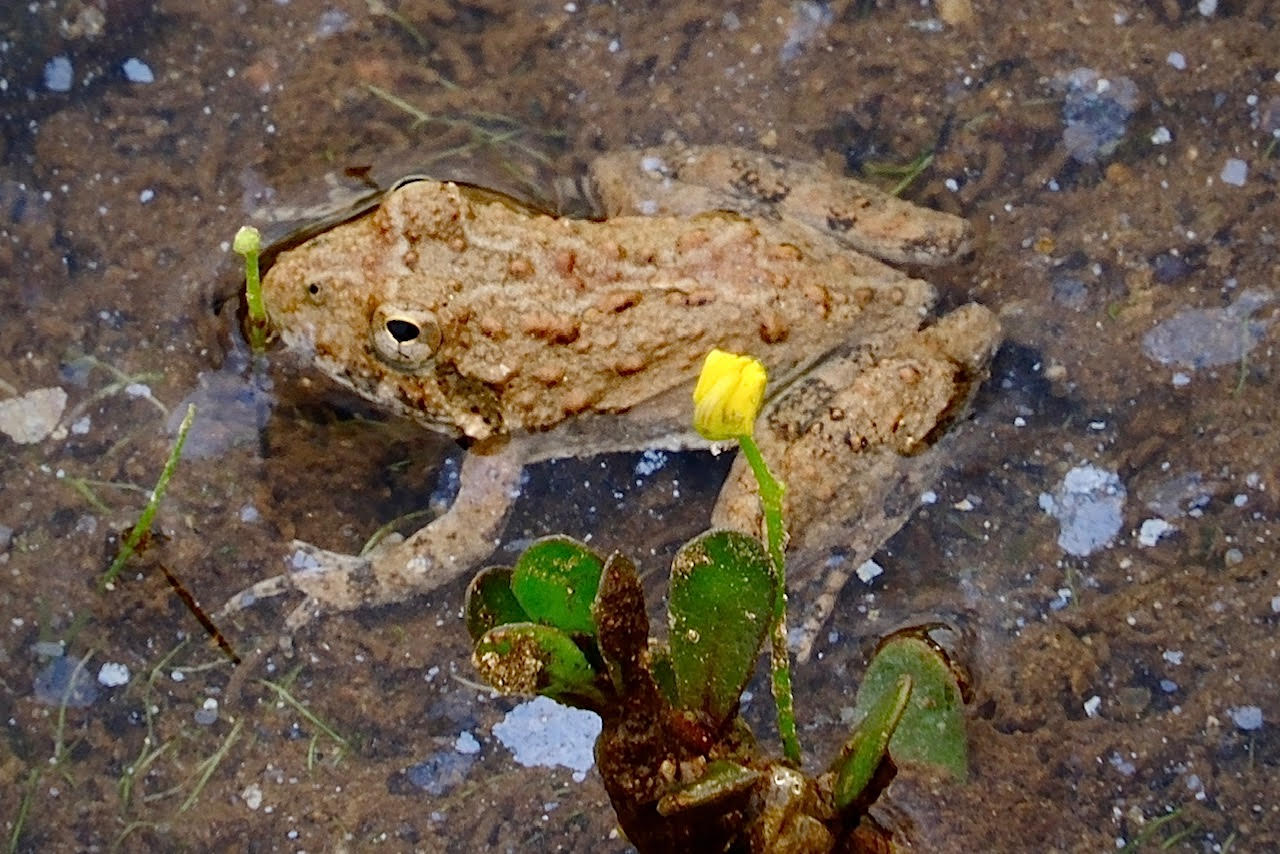
It’s currently the perfect time of year to tune into one of nature’s most curious concerts. As spring unfolds into early summer, frogs and toads chorus to attract a mate. With more than 15 species of frogs and toads in Travis County, it can be hard to hear each one in the cacophony of sound at the water’s edge. One of the most distinctive and dominant choruses you are likely to hear is a rapid series of clicks that sound like marbles tapping together. That is the Blanchard’s Cricket Frog!
For a time, Blanchard’s Cricket Frog was considered the same species as the Northern Cricket Frog, Acris crepitans, but is now recognized as its own separate subspecies, Acris crepitans blancardi. Blanchard’s Cricket Frogs are among the smallest native Texas frogs, with adults averaging .5 to 1.5 inches in length. Their skin is characteristically warty with brown, gray, tan, or olive-green coloration. Blanchard's Cricket Frogs can be identified by 3 distinctive markings: a dark triangle on the top of the head between their eyes, alternating light and dark blotches on the upper jaw, and a black or brown stripe along the inside of each thigh. They may also display an orange, green, yellow, or red stripe running down the center of the back. Their long legs and strongly webbed feet allow for them to cover impressive distances with each stroke through water. Although classified as a tree frog, Blanchard’s Cricket Frogs have underdeveloped adhesive pads on their toes and fingers, making them less equipped to climb.