Header Logo
About
Home Vision Calendar of Events History Staff & Board Contact Us
Our Work
Advocacy Overview Pristine Streams Barton Creek Hays County Williamson County Hill Country
Resources
All Newsletters Latest Issue Pristine to Polluted Report Explorer's Guide
Support Us
Donate Sponsor Us Volunteer Monthly Talks Guided Walks
← Back to all posts

2025 in review: Big changes, big accomplishments

by Brian Zabcik
Dec 17, 2025
Connect

STS NEWS 12.17.25


As we've already told you, we recently changed our name from Save Barton Creek Association to Save Texas Streams to better reflect the scope and breadth of our work. This year, our work included:

  • Stopping a bad wastewater permit on upper Barton Creek.
  • Improving another wastewater permit on the Pedernales River.
  • Writing and promoting a bill to protect the Hill Country’s most pristine streams.
  • Monitoring controversial groundwater permit applications on the Neches and Trinity Rivers.
  • Providing assistance for a successful bill to preserve the Devils River.
  • Organizing our usual full schedule of in-person events, including our monthly Happy Hour Talks, guided hikes, and collaborative workdays.


We were able to do all of this work because of your generous financial support over the past year. We have an even busier schedule of advocacy and outreach activities planned for next year. That’s why we’re asking you to continue, increase, or start your support for Save Texas Streams with a generous, tax-deductible, end-of-the-year contribution. We’re one of the oldest grassroots environmental groups in Texas, and we’re already planning for our 50th anniversary in 2029. But we can’t continue to protect our state’s streams, aquifers, and watersheds without your financial support.

Donate to Save Texas Streams


Biggest win: Stopping the Fitzhugh Concert Venue

In November, we received great news from our friends at Shield Ranch — plans for a massive music venue above Barton Creek were dead. California developer Bill Hirschman finally agreed to sell the property on which he wanted to build his amphitheater to the Shield-Ayres Foundation. Defeating Hirschman’s proposal was a priority for our organization. We publicized its problems, mobilized our members, and submitted written and oral testimony at two public meetings that TCEQ held on a draft wastewater irrigation permit for the project. 
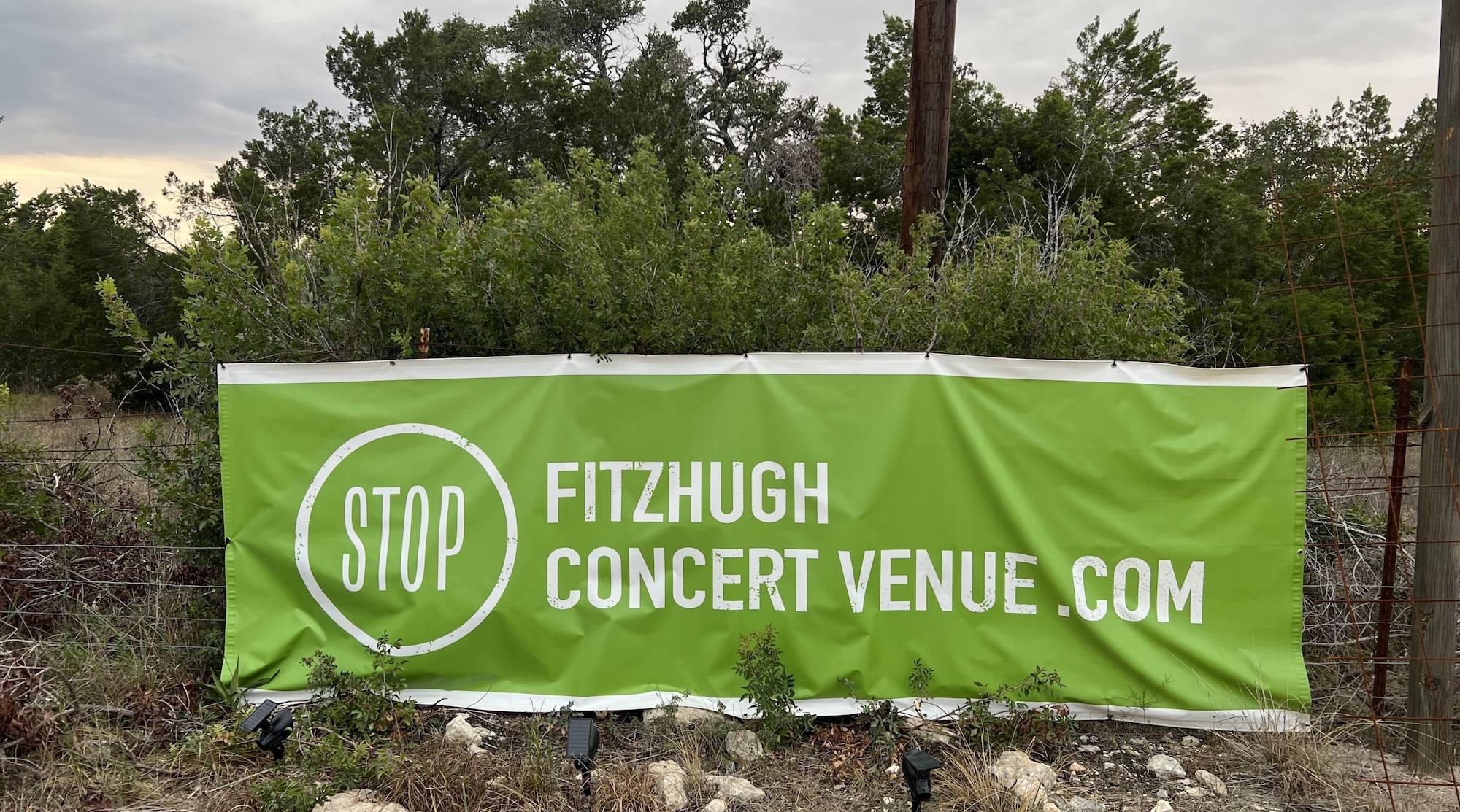
Local residents and environmental groups banded together to oppose the proposed  amphitheater

Hirschman’s proposal called for a 5,000-seat concert venue — which would have been bad enough at such a sensitive location — but he also wanted to cram an 1,823-vehicle parking lot onto the site. All told, his plans called for blanketing 66% of his property with impervious cover. A  project like this might have been appropriate in an urban location, but building it on the banks of Barton Creek — and over the Edwards Aquifer Contributing Zone — would have been disastrous. The large amount of impervious cover in Hirschman’s venue would have produced huge volumes of dirty runoff during storms, and the limited amount of open space would have increased the risk of sewage overflowing from its onsite wastewater irrigation system. 

We were proud to be part of the Stop Fitzhugh Concert Venue Coalition, which also included Shield Ranch, Fitzhugh Neighbors, Save Our Springs Alliance, Greater Edwards Aquifer Association, Travis Audubon, and The Nature Conservancy. We especially want to thank the Shield-Ayres family for their outstanding stewardship of the second-largest tract of undeveloped land on Barton Creek. Because of the combined efforts of everyone who loves Barton Creek, it’s the only stream meeting the criteria of the Pristine Streams proposal (below) that’s located in a major urban area. We’re clearly doing something right here.


Improving Mirasol Springs, delaying White Rocks

We’ve opposed many wastewater discharge permits over the years, but we’ve generally supported wastewater irrigation permits, because spreading treated sewage on the ground is a better dispersal method than dumping it into a stream. But even wastewater irrigation systems can cause problems if they’re in the wrong location. This year we worked with local landowners concerned about several wastewater irrigation permit applications in Hays and Travis Counties.

Mirasol Springs — This is a proposed luxury hotel and subdivision that Dallas billionaire Steve Winn plans to build at the Hamilton Road crossing over the Pedernales River. An especially active group of local residents, led by legendary environmental advocate Tom “Smitty” Smith, was able to win several improvements to Winn’s original proposal. Based in part on data that we provided to the landowners group, TCEQ agreed to include strict limits for phosphorus and nitrogen limits in its draft wastewater irrigation for Winn’s project. Equally important, Winn agreed to abandon his plan to use groundwater wells to supply water for his resort in favor of a water line extension from a nearby utility. 

White Rocks — This is a proposed luxury hotel and resort that notorious local developer Chris Milam wants to build on a property located at the State Highway 71 crossing over Barton Creek. More importantly, it’s within the Barton Creek Habitat Preserve, owned and managed by The Nature Conservancy and the largest undeveloped property on the creek. In fact, Milam is using the “forever unobstructed views” of the preserve as a selling point for his development’s residences, which he’ll be selling for as much as $3.5 million. After TCEQ issued a draft wastewater irrigation permit for his White Rocks this spring, we quickly alerted our partners and members. We also contacted Rep. Vikki Goodwin, who asked TCEQ to hold a public meeting on the White Rocks draft permit. We’re currently waiting for the agency to publish its official response to comments submitted at the meeting. (Read more here.)

Developer Chris Milam will use views of the Habitat Preserve to sell his multimillion-dollar condos


Protecting pristine streams at the Legislature

Our top priority during this year’s Legislative Session was to reintroduce the Pristine Streams bill, which was filed by Sen. Sarah Eckhardt as SB 1911. The bill would have managed new wastewater permits on our last remaining pristine rivers and creeks, defined as having extremely low levels of phosphorus. SB 1911 was unanimously endorsed by the Wastewater Conservation Coalition (formerly the No Dump Sewage campaign). While the bill didn’t advance in this year’s session, we were encouraged by the uniformly positive response to it that we heard from legislators whose districts contain pristine streams.

Discharged wastewater has caused excessive algae on the South San Gabriel River — the worst-case scenario for other pristine streams.

Because past versions of this proposal have been mischaracterized by opponents as bans or prohibitions, we emphasized that SB 1911 would still allow development to continue on pristine streams, since new wastewater irrigation permits would still be issued. But because the proposal would also discontinue new wastewater discharge permits on these streams, it would prevent another situation like the damaging algae growth that Liberty Hill’s wastewater has caused on the South San Gabriel River. We’re already laying the groundwork for a bigger push for the Pristine Streams proposal in the 2027 session. (Read more here.)

In addition to the positive reactions to SB 1911 that we heard from legislators, we were also encouraged by the passage of HB 3333, a newly enacted law that discontinues new wastewater discharge permits on the Devils River north of Del Rio. HB 3333 was championed by our friends at Devils River Conservancy, and we helped them with the drafting of their bill. (SBCA and DRC were two of the organizations, along with the Hill Country Alliance and Friends of Hondo Canyon, that filed the Pristine Streams petition with TCEQ in 2022.) HB 3333’s success represents the first new limit on wastewater discharge permits since 1996, when discharge permits were prohibited over the Edwards Aquifer Recharge Zone. (Discharge permits were previously discontinued around the Highland Lakes in 1986.)

Legislators also took much-needed action on other water policy issues. They passed a measure to provide $20 billion for water infrastructure projects, which Texas voters approved in November as Proposition 4. And they passed a bill to improve the Hays Trinity Groundwater Conservation District, which was unfortunately vetoed by the Governor. You can learn more about this session’s water legislation in this analysis and this webinar by STS advocacy director Brian Zabcik. 


Sharing knowledge online, in person, and in nature

In addition to changing our name, we’ve also completely changed our website at SaveTexasStreams.org. This wasn’t a simple change in the web address — STS executive director Lee Burton and operations manager Logan Ferguson produced new content, revamped the design, and moved the website to a new platform. We think you’ll agree that the result is a more informative and user-friendly website. We also continued our monthly Happy Hour Talks featuring experts on a range of environmental topics, and led several guided hikes along the Barton Creek Greenbelt. We were also able to take advantage of an unexpected and unusual opportunity — AirBnB invited us to lead hikes for guests staying in its Austin lodgings.


Donate now to help us continue our work!

From our many years in the trenches, we’ve learned what works and what doesn’t. Put simply, we have both the experience and knowledge to get things done. Thanks to your past support, we've accomplished many things as Save Barton Creek Association and with your continued support, we’ll be able to accomplish even more as Save Texas Streams. That’s why we’re asking if you can help us now with a generous donation to fund our work to protect our state’s water. 

Donate to Save Texas Streams 


Responses

Join the conversation
t("newsletters.loading")
Loading...
Tell TCEQ: Don’t flood Salado Creek
with treated sewage!
STS NEWS 01.25.26 The Texas Commission on Environmental Quality (TCEQ) has been processing permit applications for 12 new wastewater facilities that could discharge up to 8 million gallons of inadequately treated sewage every day into Salado Creek. This is one of the largest concentrations of new wastewater permit applications anywhere in Texas. Salado Creek is a pristine stream that runs over...
Sumac: Fall Colors, a Tasty Spice, and a Wildlife Café
If you’ve ever driven through the Texas Hill Country in fall, you’ve likely noticed the brilliant reds and oranges of sumac trees. With their striking fall foliage and knack for thriving where little else will grow, true sumacs of the genus Rhus bring both color and character to the landscape. Members of the Anacardiaceae family, sumacs are distant relatives of cashews, mangos, poison ivy, pois...
Vote Yes for Water - Vote Yes for Prop 4
The terrible floods that devastated the Hill Country in July obscured a basic fact: Texas is sliding into a full-blown water crisis. Two months before the floods, Canyon Lake was only 46% full; Lake Travis, 41%. While both of these crucial Hill Country drinking water sources are more full now, other reservoirs remain at dangerously low levels, especially the two that supply Corpus Christi — Cho...

Save Texas Streams Newsletter

Receive updates on key policy issues, environmental education on Central Texas ecology and natural history, and opportunities to get involved in protecting our streams and aquifers.
Footer Logo
© 2026 Save Texas Streams, a 501c3 organization
Powered by Kajabi

Join Our Free Trial

Get started today before this once in a lifetime opportunity expires.