
Salado Creek
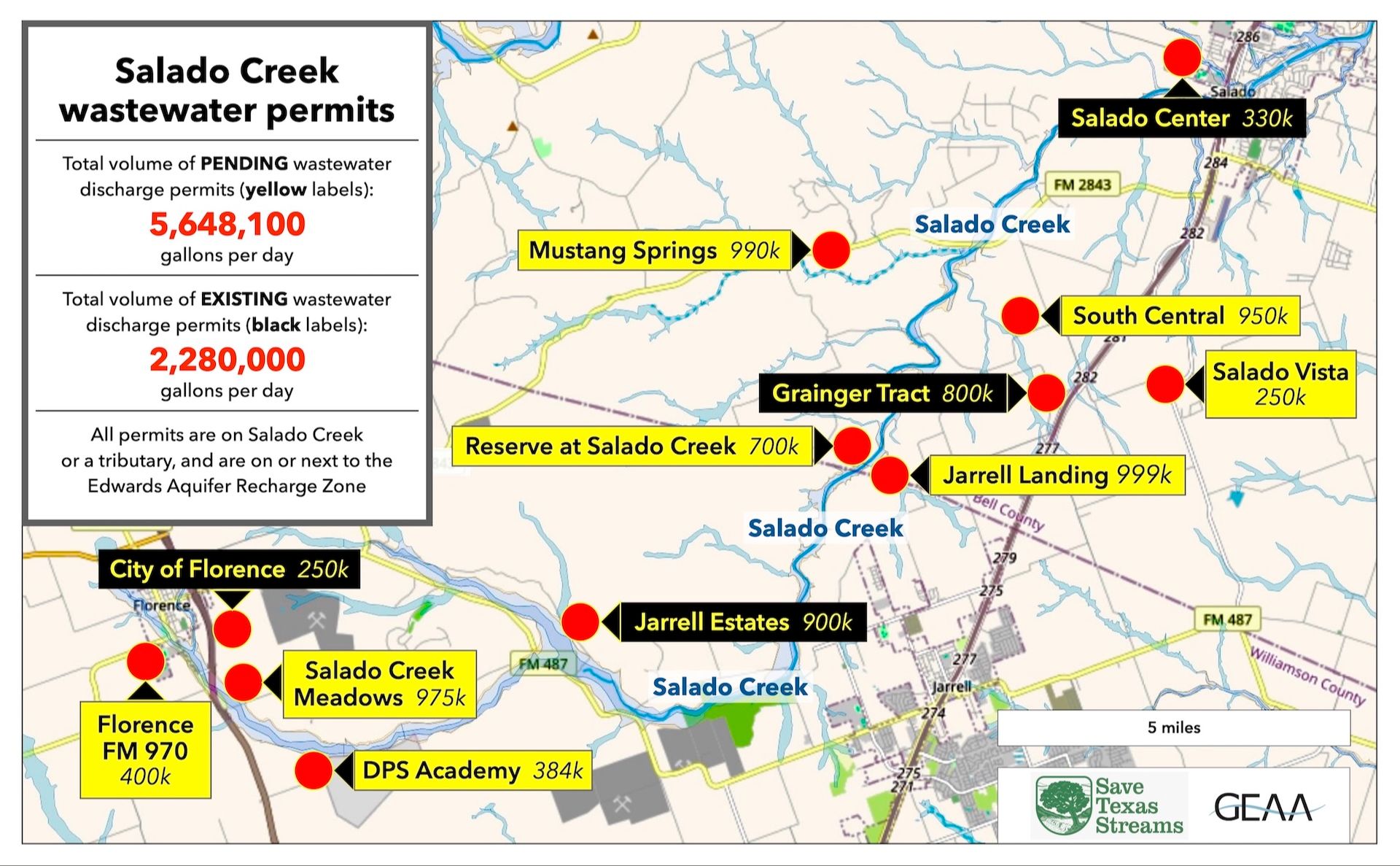
The Texas Commission on Environmental Quality is currently processing applications for 7 new permits that would allow treated sewage (domestic wastewater) to be discharged into Salado Creek in Bell and Williamson Counties. TCEQ has previously approved 4 wastewater discharge permits on the creek. Most of the pending and existing permits will be for wastewater treatment plants serving residential subdivisions near the towns of Florence, Jarrell, and Salado, a popular tourist destination. The wastewater treatment plants for these 11 pending and existing permits could cumulatively discharge 7.9 million gallons of treated sewage into Salado Creek every day — a much higher volume than what’s discharged by most big-city wastewater treatment plants. (Keep reading below for more information on the Salado Creek permits)
Upcoming Events
January 19, Monday, 5-6pm
Barrow Brewing Company, 108 Royal St, Salado TX 76571
Presentations by Brian Zabcik from Save Texas Streams and Mike Clifford from Greater Edwards Aquifer Alliance
Monthly meeting of Native Plant Society of Texas - Tonkawa Chapter
January 20, Tuesday, 5-6pm
Barrow Brewing Company, 108 Royal St, Salado TX 76571
Presentation on Salado Creek permits by Brian Zabcik from Save Texas Streams
TCEQ Public Meeting on the permit for Reserve At Salado Creek
January 27, Tuesday, 7-9pm
Salado ISD Administration Office, 601 N. Main Street, Salado TX 76571
Representatives from TCEQ's staff and from the permit applicant, South Central Water Company, will take questions from the public.
Submitting online comments on the permit for Reserve At Salado Creek
Members of the public and other interested parties may submit online comments on TCEQ's website through January 27. Comments must be limited to the permit for the Reserve At Salado Creek.
Go to: https://www14.tceq.texas.gov/
Enter permit number: WQ0016658001
Salado Creek is an exceptionally pristine and spring-fed stream, and it will not be able to handle such a high volume of treated wastewater. Because the creek has little to no flow during dry months, it will essentially be transformed into a sewage drainage ditch. The 7 pending permits, combined with the 4 existing permits, represent one of the highest concentrations of new wastewater permits anywhere in Texas.
Several of the pending wastewater discharge permits around Salado Creek are also in the Recharge Zone of the Edwards Aquifer. In 1996, TCEQ banned new wastewater permits in the Edwards Recharge Zone south of the Colorado River. If that ban had been extended to the full extent of the Recharge Zone north of the Colorado River, most of the current permits on Salado Creek could not be issued by TCEQ. Further, while TCEQ still issues TLAP irrigation permits in the southern extent of the Edwards Recharge Zone, it only approves one type of dispersal method — surface spray irrigation — but not the other — subsurface drip irrigation. TCEQ's rationale for not approving subsurface drip over the Recharge Zone is the same reason it doesn't issue wastewater discharge permits in this area — in order to protect the water supply for millions of Texans who get their water from wells drilled in the Edwards Aquifer.
The problems with the pending permits on Salado Creek would be exacerbated by the inadequate treatment requirements that TCEQ has drafted for them. In particular, these pending permits would have very high or no limits on the amount of phosphorus that could remain in wastewater after it’s been treated and before it’s discharged. Phosphorus is a plant fertilizer, and adding more of it to pristine streams with very low amounts of naturally occurring phosphorus will fertilize the growth of excessive algae.
This has already happened in Williamson County west of Georgetown. The South San Gabriel River, which is also a pristine stream with little phosphorus, has been blanketed with excess algae for several miles below the point where Liberty Hill discharges its treated wastewater, which contains higher levels of phosphorus (see photo montage below). The draft permits that TCEQ has written for the pending applications on Salado Creek would allow treated wastewater to be discharged with 15 to 100 times more phosphorus than what’s in the creek. And while Liberty Hill was only discharging around 1 million gallons of treated wastewater into the South San Gabriel, the 11 existing and pending permits on Salado Creek could potentially discharge up to 8 million gallons per day.
The 7 pending wastewater discharge permit applications are at different stages in TCEQ’s approval process. The agency will hold a public meeting on one of these applications, for The Reserve At Salado Creek, on January 27. Concerned residents are holding several community meetings prior to the TCEQ meeting.
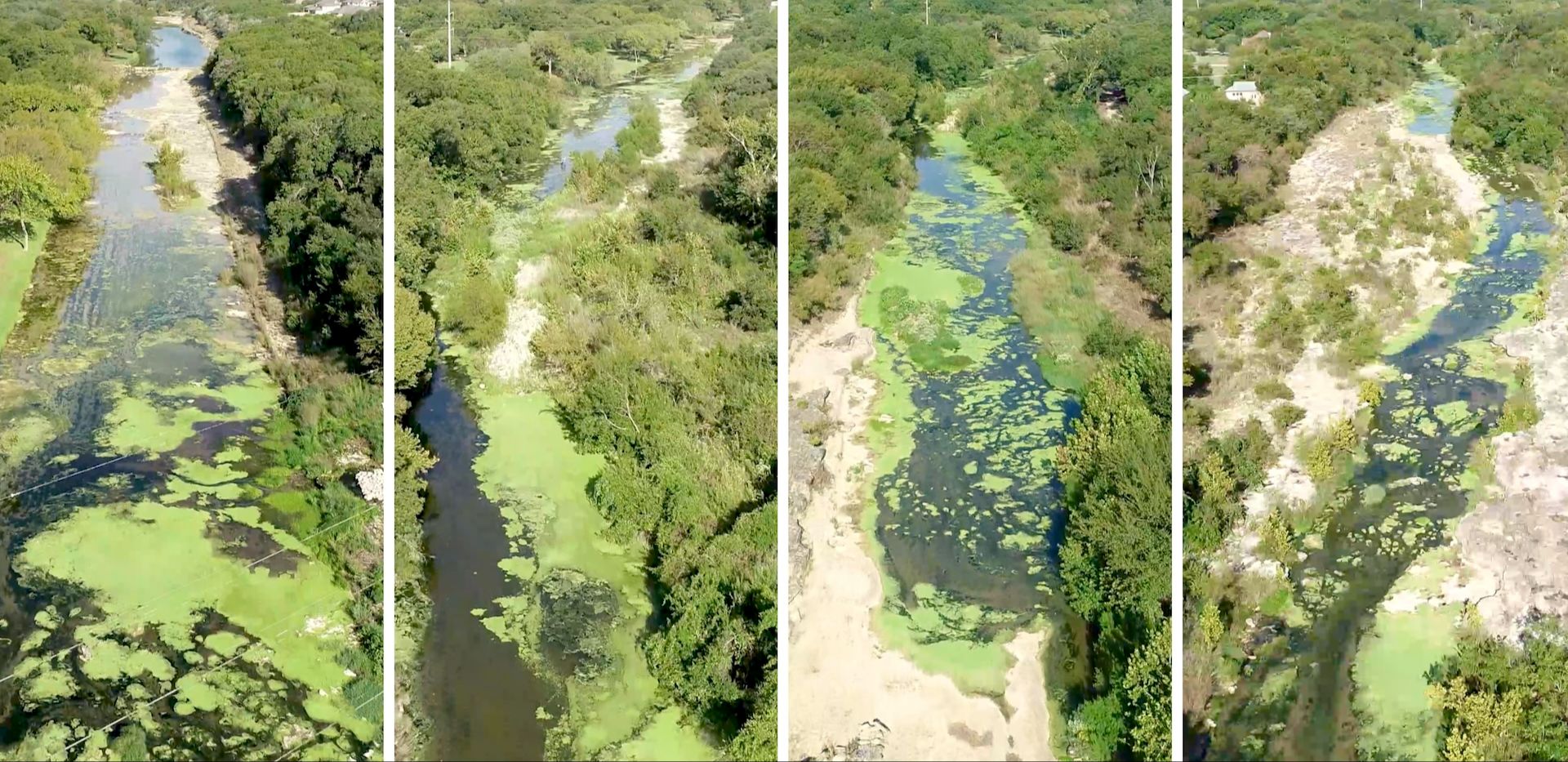
The South San Gabriel River (above), which is located 20 miles south of Salado Creek, has been plagued with excessive algae caused by treated wastewater for more than a decade. This montage shows consecutive segments of the South San Gabriel as seen in a drone video shot in 2020 by Ryan King, a nationally renowned water quality scientist at Baylor University. These images showed how excessive algae grew on the South San Gabriel for miles downstream from the city of Liberty Hill's wastewater discharge outlet, located at the midpoint of the photo at far left.
The chart below shows how the pending permits on Salado Creek compare to benchmark permits and rules previously issued by TCEQ. The agency banned new discharge permits on the Edwards Aquifer Recharge Zone in 1996, but only south of the Colorado River. Most of the pending permits on Salado Creek are located on the northern tip of the Recharge Zone. The lowest phosphorus limit in any of the Salado Creek permits is 0.15 milligrams per liter. TCEQ first set this limit in 2008; wastewater treatment technology has advanced considerably since then. In 2024, TCEQ renewed the discharge permit for the city of Liberty Hill with a much lower phosphorus limit of 0.02 milligrams per liter. Liberty Hill discharges its wastewater into the South San Gabriel River, which is a pristine stream with very similar characteristics to Salado Creek. (See chart key below)
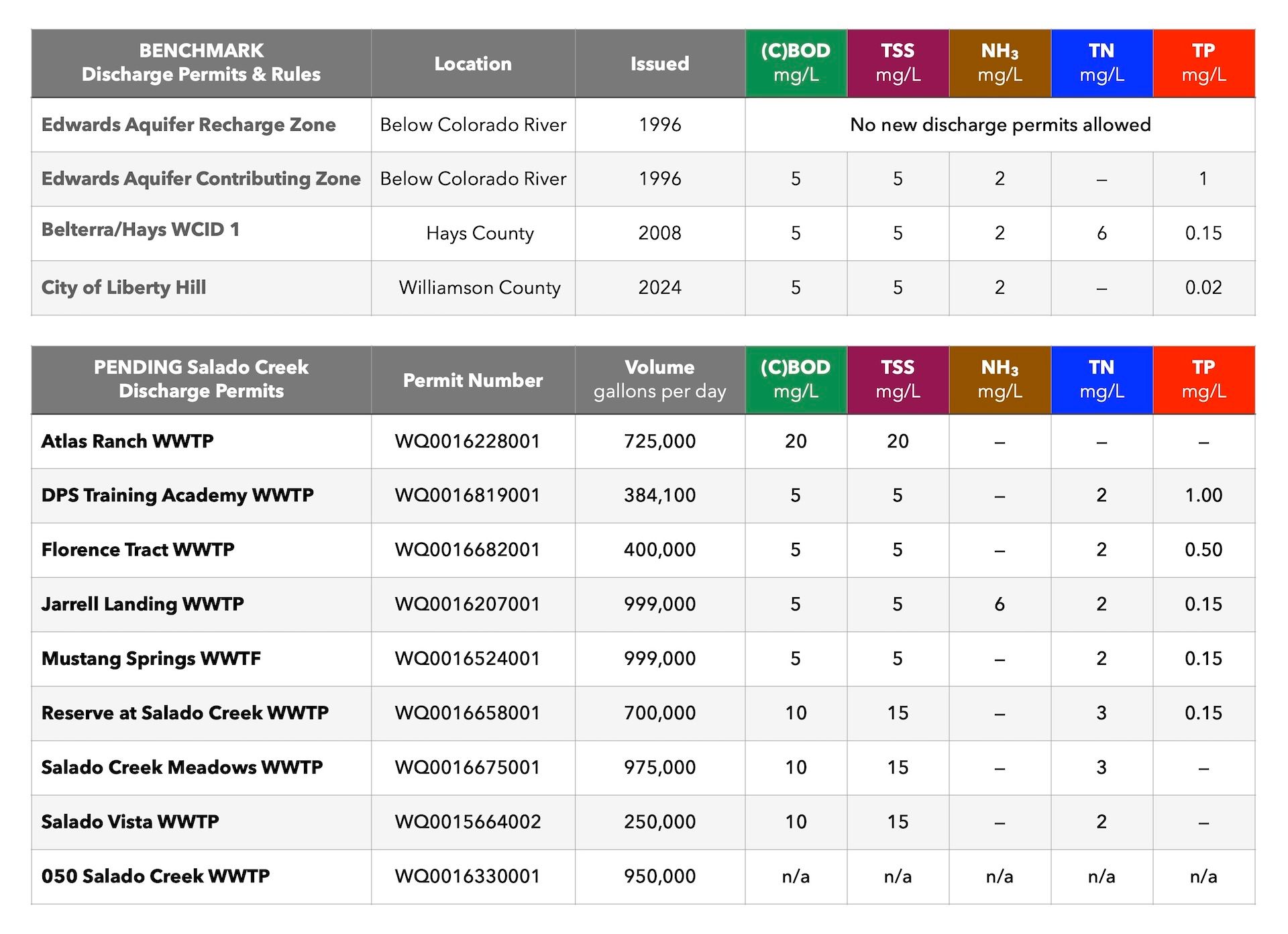
Carbonaceous Biochemical Oxygen Demand (CBOD) — This is an indirect measure of how well wastewater has been treated. A high CBOD level means that the discharged wastewater will deplete a higher amount of dissolved oxygen in a stream, which can lead to fish kills.
Total Suspended Solids (TSS) — This is also an indirect measure of how well wastewater has been treated.
Ammonia Nitrogen (NH3) and Total Nitrogen (TN) — Ammonia in discharged wastewater can break down into harmful nitrites and nitrates.
Total Phosphorus (TP) — Because phosphorus fertilizes the growth of plants, a high TP level in discharged wastewater can fertilize the growth of excessive algae in streams with very low levels of naturally occurring phosphorus, such as Salado Creek.
Permit information compiled by Mike Clifford, technical director, Greater Edwards Aquifer Alliance (GEAA)