
Hays Commons
An uncommonly bad development
If you wanted to build a big subdivision in a really bad place, where would you put it? Would you build it where surface water can seep directly into the Edwards Aquifer, a source of drinking water for hundreds of nearby wells? And would you build it in the watershed of one of the last pristine streams in Texas? Unfortunately, this is exactly what Milestone Community Builders wants to do. The Austin-based company plans to construct its Hays Commons subdivision in one of the worst places possible — over the Edwards Aquifer Recharge Zone, and in the Onion Creek watershed. Milestone has proposed building more than 700 houses in its subdivision, which would be located northwest of Buda at the intersection of SH 45 and FM 1626.
Unlike most aquifers in Texas that hold water in underground layers of wet sand or gravel, the Edwards is unique because it stores water in karst, a type of limestone (see the photo at the top of this page for an example). Karst is often compared to Swiss cheese because it’s riddled with countless cracks and holes, ranging in size from tiny veins to large caves. In the Recharge Zone, surface water seeps through fissures and openings in the ground and down into the Edwards, where it then flows through the empty spaces in the karst rock. An aquifer located in karst doesn’t filter out pollutants. If the water that seeps into the Edwards Aquifer contains pollutants, those pollutants will still be in the water that’s pumped out by nearby residential wells.
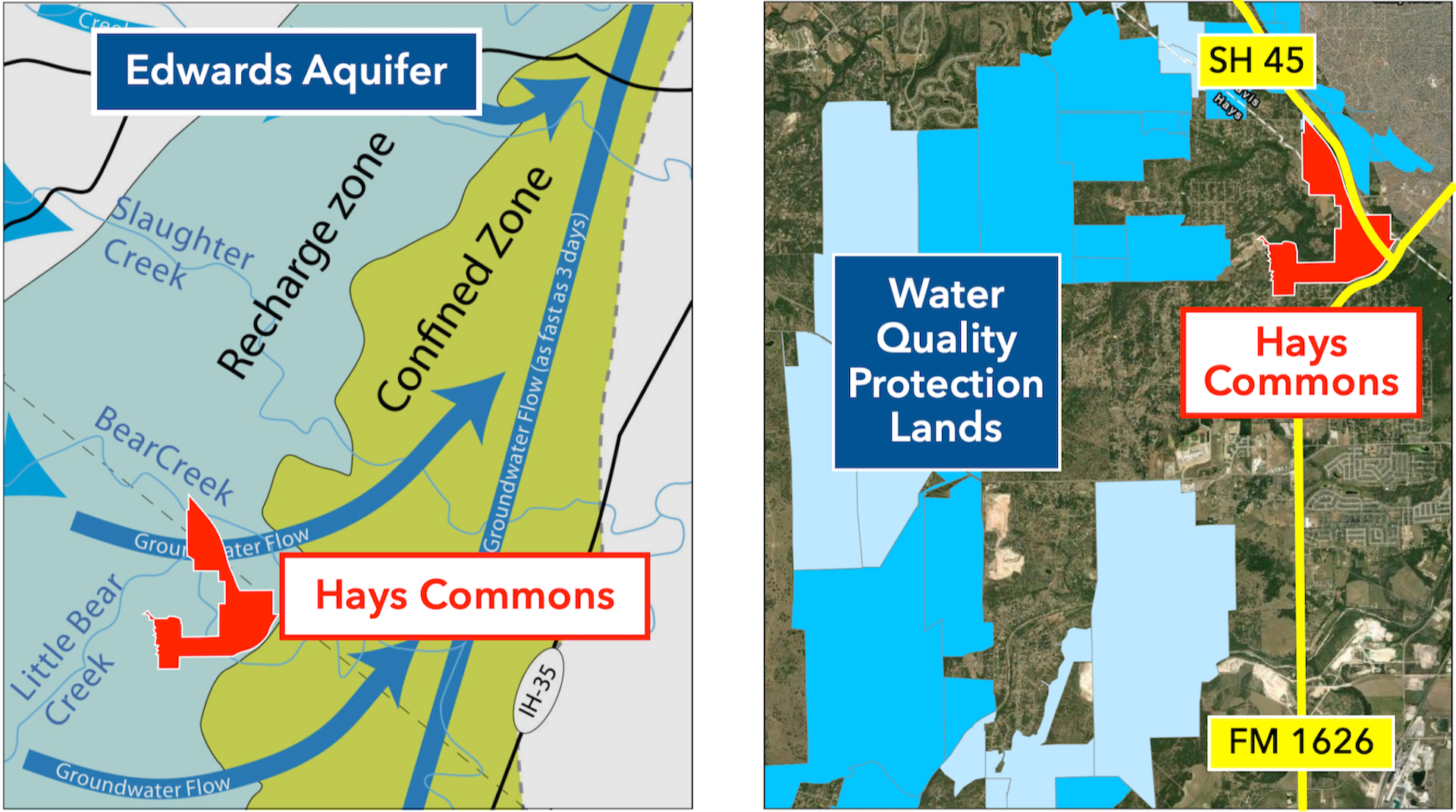
Hays Commons would be located over the Edwards Aquifer Recharge Zone (left). In the aquifer, water flows underground in the direction of the blue arrows towards Barton Springs. That's why the City of Austin has purchased hundreds of acres as Water Quality Protection Lands, where development is permanently prohibited to keep the water in the aquifer as clean as possible.
The potential for wastewater pollution
The Texas Commission on Environmental Quality (TCEQ) has already issued a draft wastewater permit for the Hays Commons subdivision. This permit, officially known as a Texas Land Application Permit (TLAP), would allow Hays Commons to irrigate its treated wastewater (aka sewage) onto land. Getting rid of treated wastewater this way is usually a better option than discharging it into streams, but irrigation isn’t without its own problems. Irrigation systems can turn into discharge systems if wastewater is applied onto saturated fields, which causes runoff. Nearby wastewater irrigation systems in the Belterra, Barton Creek West, and West Cypress Hills subdivisions have had incidents of wastewater runoff, and TCEQ fined Dripping Springs in 2017 for allowing treated wastewater to run off into Onion Creek.
Irrigation fields can become saturated when they’re still wet from heavy rains, but this can also happen because of maintenance and monitoring failures. Because wastewater irrigation systems are assumed to be less problematic than wastewater discharge systems, they may not be monitored and maintained as rigorously. While wastewater discharge systems are required to regularly report their own monitoring data to TCEQ, wastewater irrigation systems are not, making it impossible for the public to know how reliable they are. The Hays Common irrigation fields would be located around several sensitive karst features in the Recharge Zone. Because there are currently no active wastewater irrigation permits that are located in the Recharge Zone itself, TCEQ has no actual knowledge about whether permits of this kind could pollute drinking water in the Edwards Aquifer.
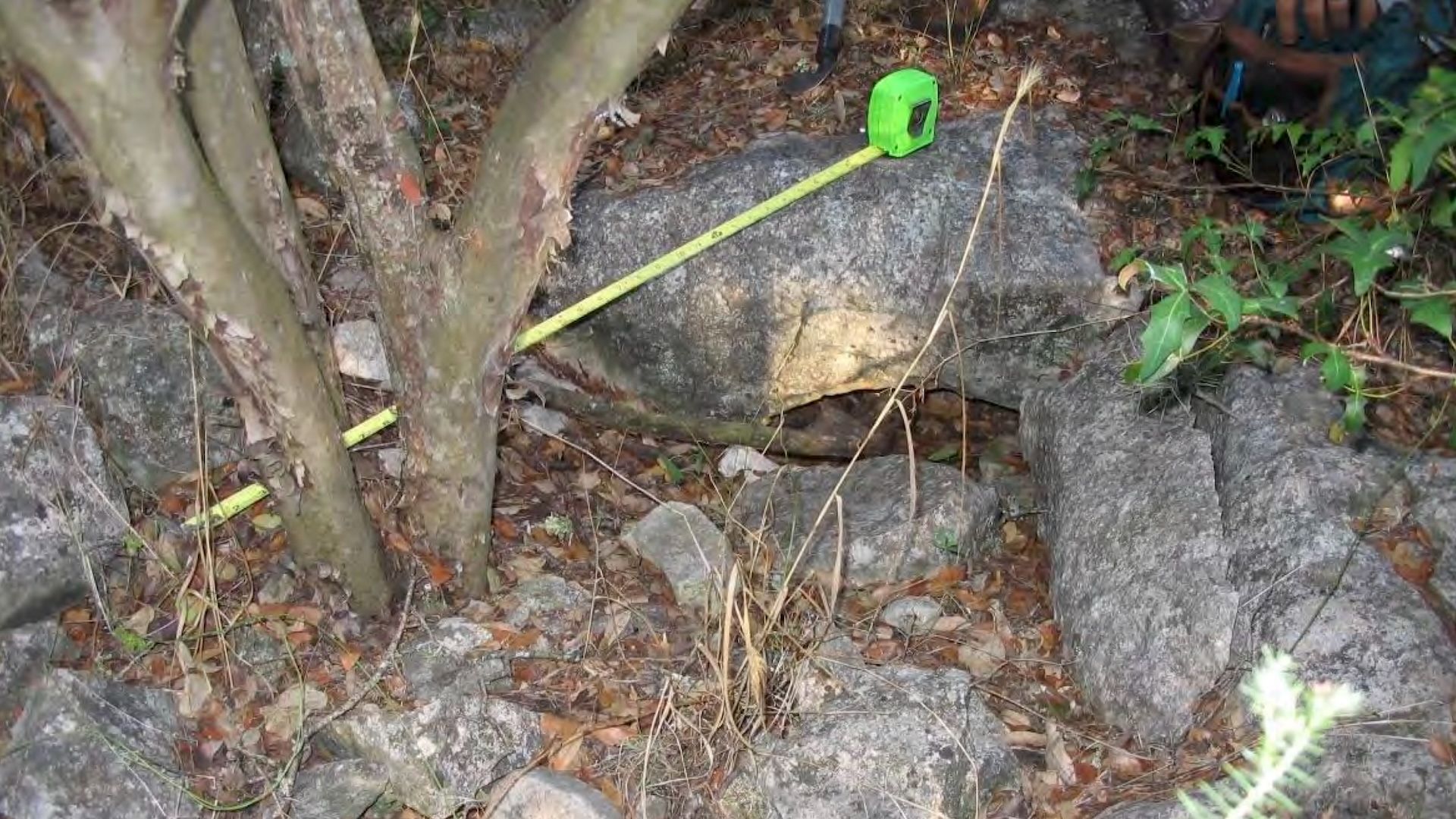
Water seeps into the Edwards Aquifer through surface fissures and openings in the karst limestone such as this one. Many of these "recharge features," as they're called, have been discovered throughout the Hays Commons property.
The potential for stormwater pollution
When rain falls onto ground that’s still in its natural and undeveloped state, most of the water will soak into the soil where it falls. Roofs, roads, parking lots, and sidewalks are called “impervious cover” because water can’t soak through these surfaces. Instead, rainwater will flow away as runoff, and it will carry away any substances that have accumulated on these surfaces between storms, including chemicals, trash, and waste. This runoff can be very dirty. According to some studies, the first inch of rain that falls on roofs and roads can be as polluted as raw untreated sewage. Adding new impervious cover to an undeveloped property — which Hays Commons would do — will increase the amount of runoff for the property. Dirty runoff from the subdivision would seep directly into the Edwards Aquifer Recharge Zone and contaminate its water..
Hays Commons also would straddle Little Bear Creek, a tributary of Onion Creek. TCEQ has recognized Onion Creek as one of the last remaining pristine streams in Texas. This means that it has exceptionally low levels of naturally occurring pollutants. If Hays Commons is built, it will create more rain runoff that will increase the risks of pollution and flooding for downstream residents on Onion Creek.
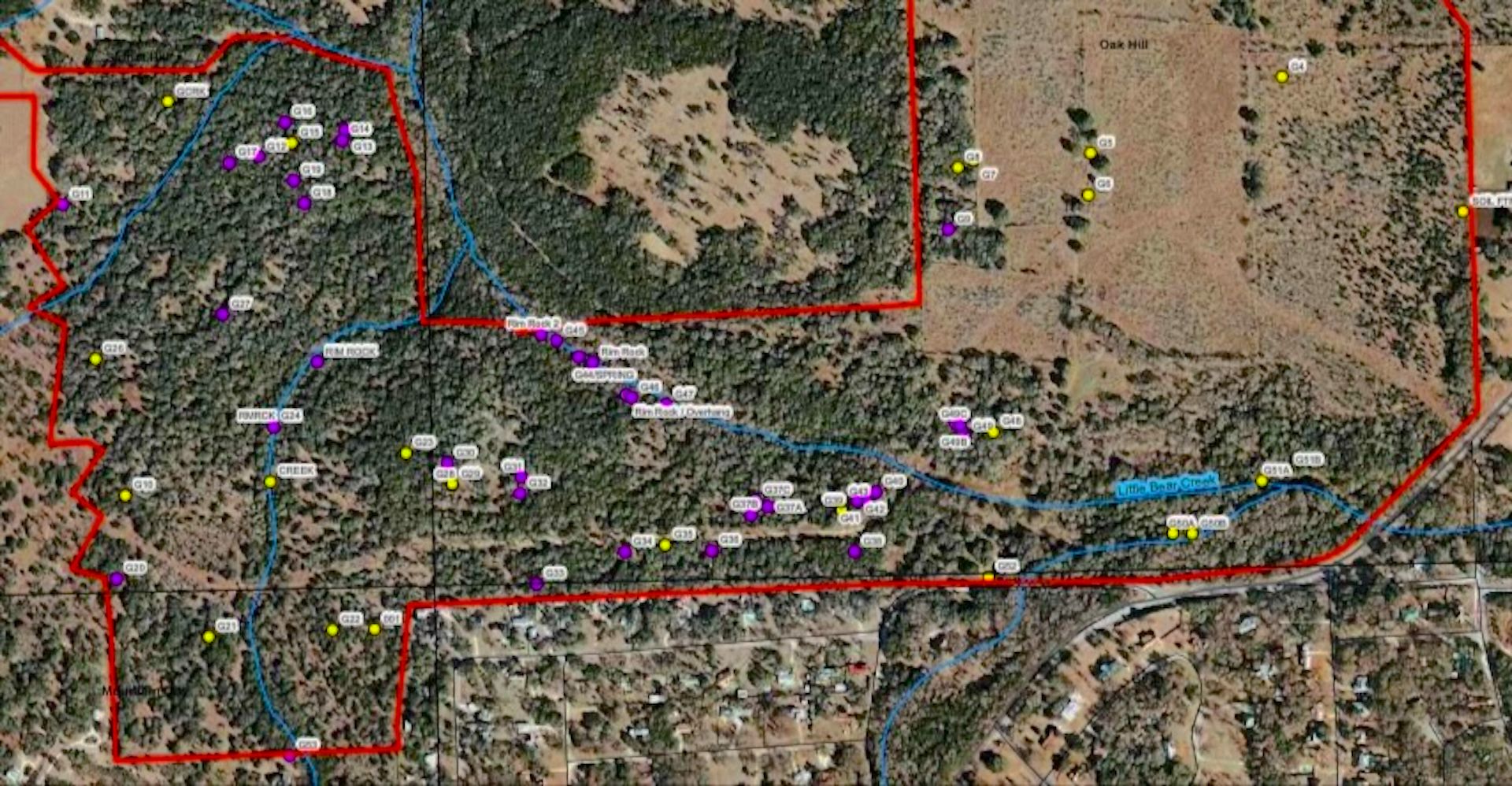
A 2008 geological survey identified many recharge features, indicated by the yellow and purple dots on this map, in the southern portion of the Hays Commons tract.
The history of Hays Commons
In 1986, Austin officials opposed an application for a wastewater permit for a proposed development that would have been located in the city’s ETJ area and just north of the Hays Commons tract. The officials based the city’s opposition on the grounds that this development would have encouraged sprawl. In 2017, the previous owner for the southern half of the Hays Commons property asked Austin to extend its water and wastewater lines to the property, but the city refused, saying that the extension “would facilitate increased development intensity in an environmentally sensitive area.”
Developers can now withdraw a property from a city’s ETJ authority under SB 2038, a new law enacted by the state in 2023. Properties that have withdrawn from municipal ETJ areas are now regulated by counties, which have much weaker development requirements than cities. Milestone has already withdrawn the southern half of its Hays Commons property from the ETJ for the City of Hays. This half is now under the jurisdiction of Hays County. Milestone could also withdraw the northern half from Austin’s ETJ if it decides to not work with the city.