
Hays County
CURRENT ISSUES
Hays Commons • Aqua Texas • State Highway 45 Extension
Warning lights for overdevelopment are flashing red all over Hays County. Subdivisions are being built or proposed in unincorporated areas where county officials have less authority than city officials to require sustainable development. Groundwater officials don’t have enough authority to make sure that the county's aquifers aren’t overpumped. The shrinking amount of green space can't be preserved as parks or conservation easements because of limited resources. And new highways would bring even more growth into areas already overstressed by existing development. There's no question that Hays County will keep growing. The real question is whether it will grow in a good way.
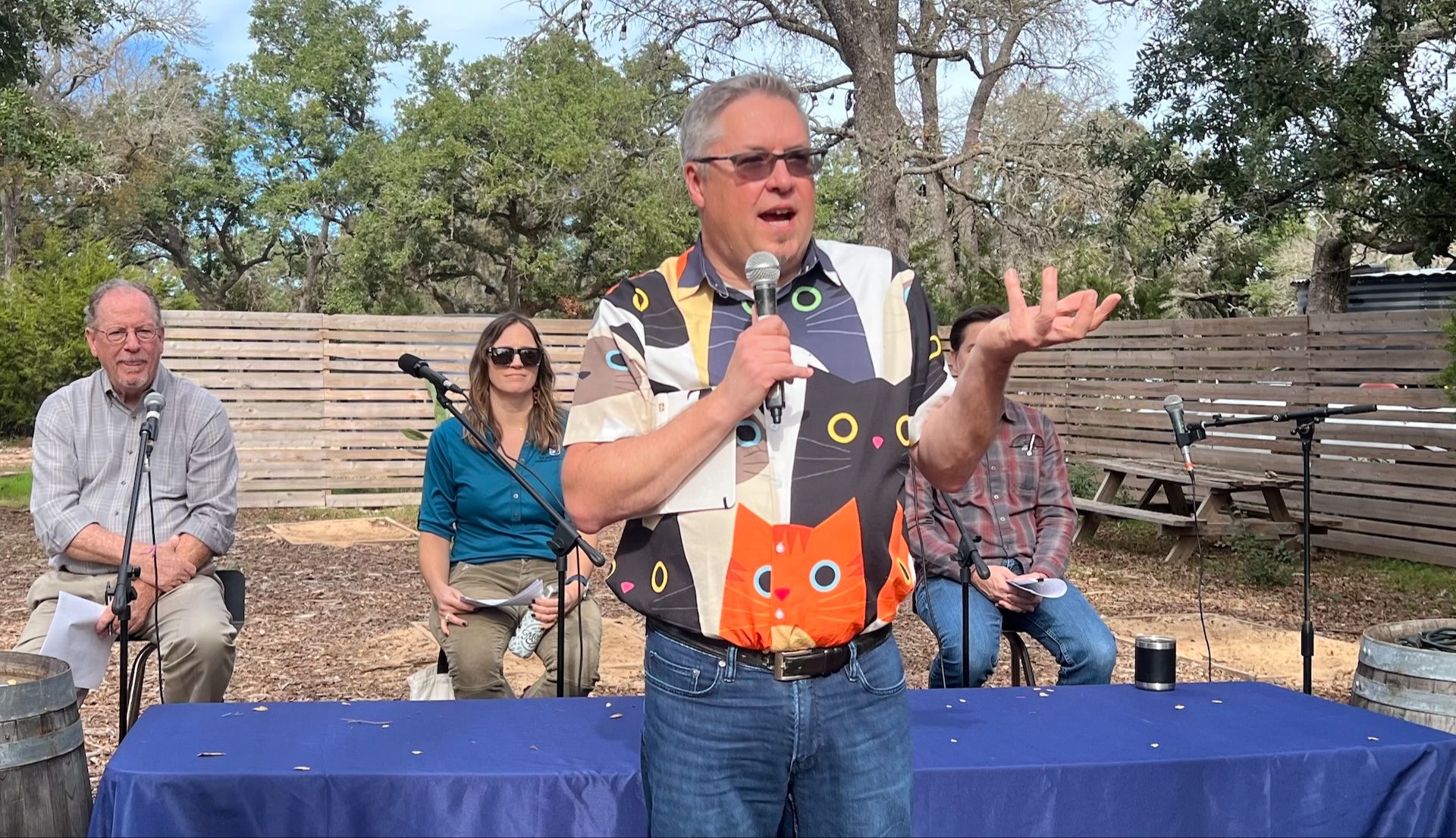
WHAT WE DO: In 2023, we organized the Hays County Growth Talk, which was co-sponsored by Clean Water Action, Greater Edwards Aquifer Alliance, San Marcos River Foundation, Save Our Springs Alliance, and The Watershed Association. Our panel discussion included Douglas Wierman (seated left), Jenna Walker (seated center), and Robert Mace (standing), all with the the Meadows Center for Water and the Environment, as well as Jay Blazek Crossley from Farm&City and Scott Way from the Hays County Parks & Open Space Advisory Commission.
Hays Commons Subdivision
WHAT'S THE LATEST? The Hays County Commissioners Court voted 3-1 on June 29, 2026, to reject a development agreement submitted by Milestone Community Builders for Hays Commons, a planned subdivision that would be constructed over the Edwards Aquifer Recharge Zone on the Hays-Travis county line. Milestone’s key dilemma has been how to get water and wastewater service for its high-density subdivision. The company has been pursuing two pathways that we’ve called the “A La Carte Option” and the “Buffet Option’ (see our chart below). Under the Buffet Option, Milestone would get all of the development approvals and services that it needs from a single source — the City of Austin. Under the A La Carte Option, Milestone would get the approvals that it needs for Hays Commons from several different sources — an onsite wastewater treatment permit from TCEQ, a groundwater pumping permit from Barton Springs Edwards Aquifer Conservation District, and development approvals from Hays County and Austin. You can read more in our Hays Commons explainer.
WHAT'S HAPPENING? Milestone’s plans have constantly fluctuated, but it’s talked about building around 700 single-family homes and 12 acres of commercial space in Hays Commons. The subdivision would be located on a 498-acre property located west of Manchaca and north of Buda at the intersection of SH 45 and FM 1626. Most of the tract lies over the Edwards Aquifer Recharge Zone, which is the drinking water source for many nearby wells. Milestone’s subdivision would also straddle Little Bear Creek, which flows into Onion Creek, one of the last pristine streams in the state.

WHAT WE DO: Save Texas Streams has been actively involved in the debates over Hays Commons along with our partners at Save Our Springs Alliance (SOS), Greater Edwards Aquifer Alliance (GEAA), and Hays Residents for Land & Water Protection. We joined our friends at HRLWP at a recent neighborhood fair to distribute information about Hays Commons. From left: Darlene Starr and Alonna Beatty of HRLWP; Logan Feguson, STS operations manager; Carol Pennington of HRLWP; and Brian Zabcik, STS advocacy director. You can subscribe to HRWLP's newsletter by emailing Hays Residents for Land & Water Protection.
Aqua Texas Overpumping
WHAT'S THE LATEST? At the end of the 2025 Legislative Session, Governor Greg Abbott vetoed SB 1253, which would have given the Hays Trinity Groundwater Conservation District the same powers as other GCDs in the state. The bill was necessary so that Hays Trinity could properly regulate permit-holders like Aqua Texas that have repeatedly pumped more from their wells than allowed. You can read more in this Texas Monthly story.
WHAT'S THE PROBLEM? Most Hays County residents rely on wells for their water supply. On the west side of the county, the Hays Trinity Groundwater Conservation District issues permits for wells drilled into the Trinity Aquifer, while the Barton Springs Edwards Aquifer Conservation District (BSEACD) manages well permits on the east side. But while the two districts have equal responsibility for managing the county’s water supply, they don’t have equal authority. When the Texas Legislature created the Hays Trinity GCD in 1999, it hobbled the district with an inadequate and unreliable funding structure, and with weaker provisions that deviate from the laws governing other groundwater conservation districts in the state.

Aqua Texas has pumped more water from its well that serves Woodcreek (above) than its permit from Hays Trinity GCD allows. The company's overpumping is one of the reasons that the Jacobs Well spring has gone dry in recent years.
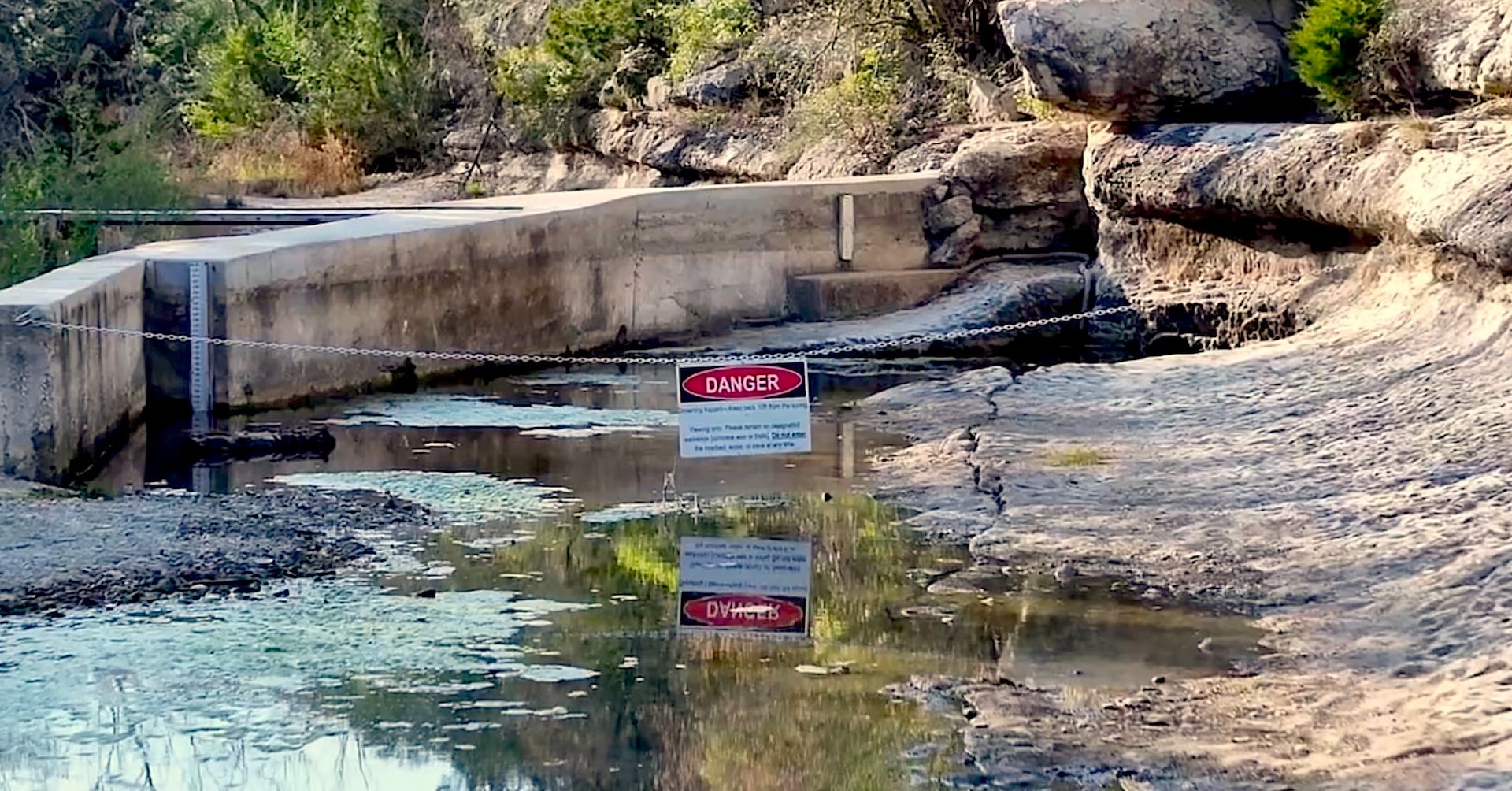
As a result, the Hays Trinity GCD has had difficulties with well owners who won’t comply with their permits. The investor-owned water utility Aqua Texas overpumped its permit for a well at Woodcreek in northern Hays County by 90 million gallons in 2022. and by 70 million gallons in 2023. The company's overpumping at Woodcreek was one of the reasons why the nearby spring at Jacobs Well went dry for an extended period.Yet rather than agreeing to follow the rules that the Hays Trinity GCD has established to benefit all of its permit holders, Aqua Texas actually filed suit to reduce the district’s already restricted authority. Aqua Texas is a unit of Pennsylvania-based Essential Utilities, which has a market capitalization of $10 billion — much, much larger than Hays Trinity GCD’s annual budget. You can learn more about the Aqua Texas controversy from our partners at The Watershed Association: here, here, here, and here.)
State Highway 45 Extension
WHAT'S THE LATEST? A road bond passed by Hays County voters in November 2024 would have allocated $7 million to a design study for SH 45, but was invalidated in 2025 as the result of a lawsuit brought by county residents who alleged that Hays commissioners failed to follow proper procedures when they placed the bond on the ballot. The Hays County Commissioners Court is currently exploring new ways to fund the projects that would have been supported by the bond.
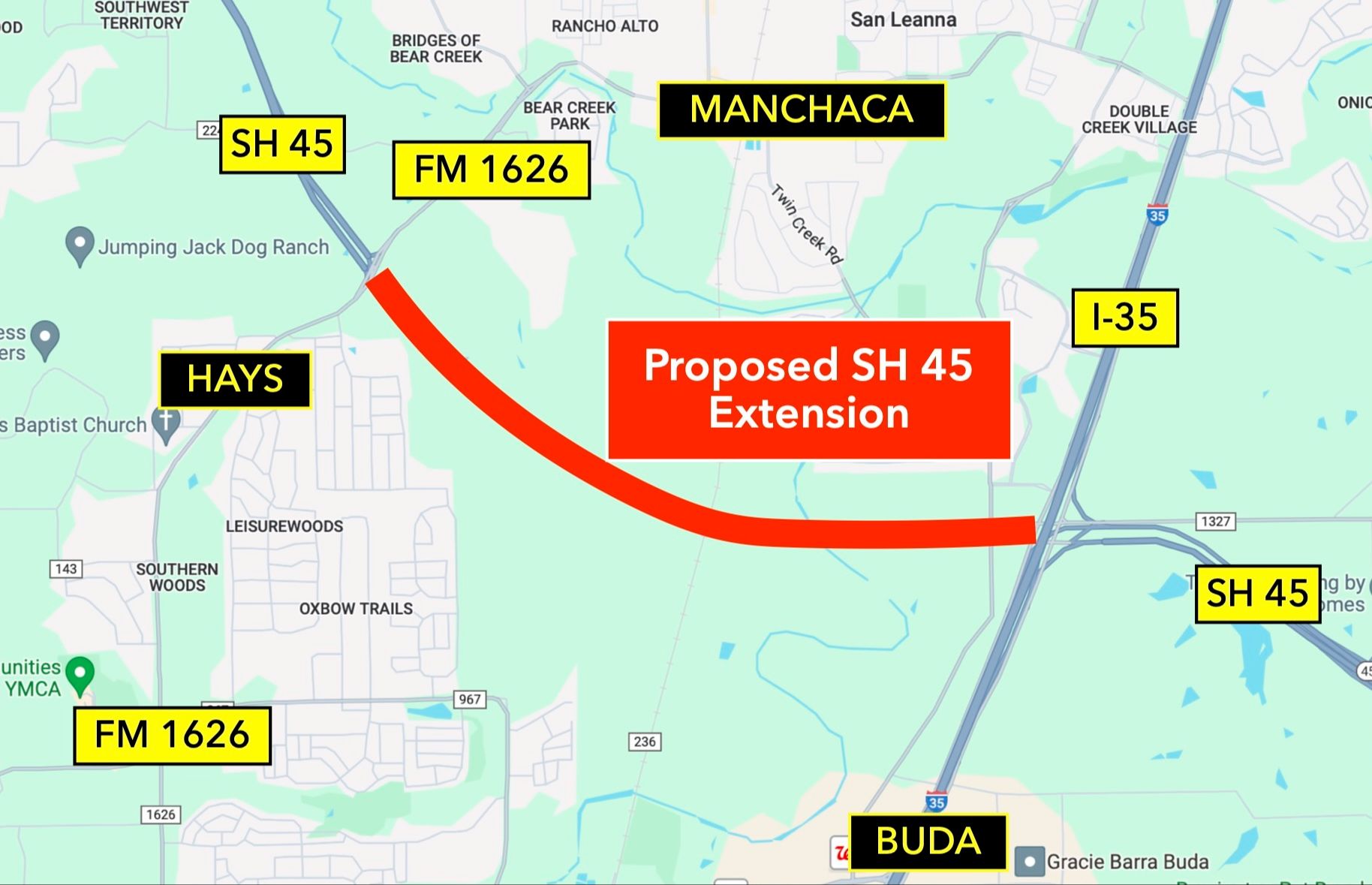
WHAT'S HAPPENING? In 2023, the Hays County Commissioners Court and the Buda City Council started a feasibility study on building a new roadway that would connect State Highway 45 between RM 1626 and Interstate 45. The southwest section of SH 45 currently ends at RM 1626, while the southeast section ends at I-35. Three open houses were held as part of the feasibility study in which planners asked for the public's input and presented initial routes. Hays County commissioners placed a $440 million road bond on the November 2024 ballot that would have funded 21 projects, including a followup design study for SH 45. While the bond was approved, the vote was invalidated in a lawsuit filed by Hays residents because of procedural errors in the commissioners' deliberations on the bond.
WHAT'S THE PROBLEM? Our organization, as Save Barton Creek Association, has been engaged in advocacy on the southwest section of SH 45 for decades We filed suit in 1988 against the original poan for what was then called the "Outer Loop" for Austin, because its proposed route would have severely harmed water quality in the Edwards Aquifer Recharge Zone. The section of SH 45 that was eventually built between Mopac (Loop 1) and RM 1626 is subject to requirements contained in a consent decree reached between the Texas Department of Transportation and the Barton Springs Edwards Aquifer Authority, joined by Save Texas Streams. One of the requirements is that this Parkway section of SH 45 cannot be expanded beyond its current lanes. However, traffic on the Parkway segment between Mopac and RM 1626 would be sharply increased if it were to be connected to a new Extension segment of SH 45 between RM 1626 and I-35. The increased traffic would also lead to an increase in runoff pollution from the Parkway segment, which would flow over the Edwards Aquifer Recharge Zone. Increased traffic will certainly happen if the proposed Extension is built, because it would turn the northwest and southwest segments of SH 45, combined with Mopac, into a western bypass for Interstate 35.